EN
EN

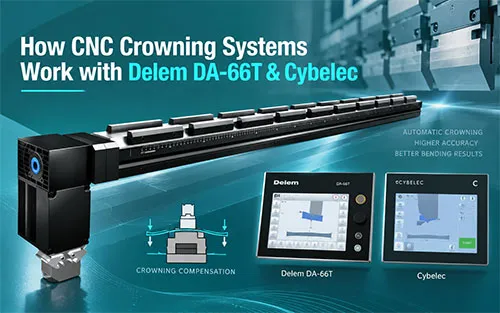
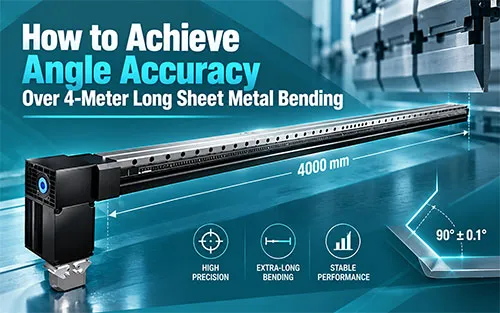
A CNC crowning system works together with the press brake controller to compensate for machine deflection during bending.
Instead of asking the operator to manually adjust the crowning table for every job, the CNC system can use programmed bending parameters and machine configuration to command an appropriate compensation value.
The basic control chain is:
Bending Program → CNC Controller → Crowning Command → Drive/Valve System → Crowning Mechanism → Deflection Compensation
On a Delem DA-66T or compatible Cybelec-equipped press brake, crowning can therefore become part of the bending program rather than a separate manual adjustment.
The result is especially valuable for:
Long parts + High bending forces + Stainless steel + High-strength steel + Repeat production
Consider a 4-meter workpiece.
Without sufficient compensation:
Left 90.1° → Center 91.6° → Right 90.0°
The operator can manually adjust the crowning table until the center reaches the target angle.
That works—but what happens when the next job changes from:
2 mm mild steel
to
6 mm stainless steel?
Or from a 1-meter bend to a 4-meter bend?
The required force and machine deflection change.
A CNC-integrated crowning system reduces the need to treat crowning as an isolated manual setting.
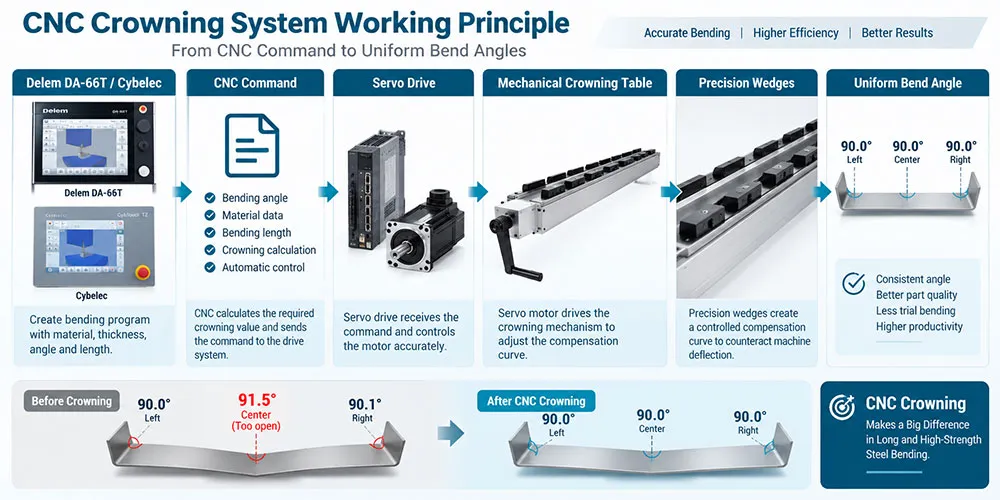
The easiest way to understand the system is to separate it into five layers.
The operator enters or selects information such as:
Material
Thickness
Bend length
Bend angle
Tooling
V-die opening
Bend sequence
The Delem or Cybelec controller manages the bending program and coordinates relevant machine functions.
Delem describes its architecture as combining low-level control of hydraulic/electrical systems with higher-level functions such as product programming, tooling setup and bend-sequence calculation.
Based on the configured machine and bending program, the control system determines or applies the required crowning command.
Depending on machine design, this command can ultimately operate a:
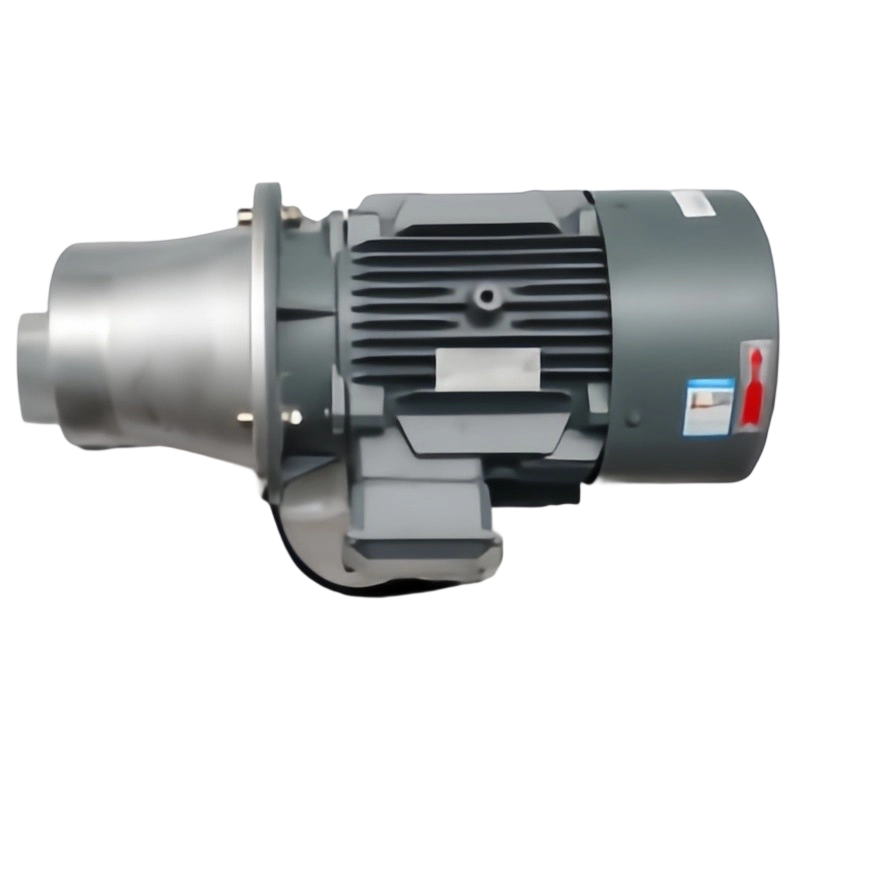
Servo motor / geared motor / hydraulic proportional system
The actuator changes the mechanical wedge position or hydraulic compensation level.
The complete relationship can be visualized as:
Material & Tooling Data
↓
Delem / Cybelec CNC
↓
Calculated / Programmed Crowning Value
↓
Machine Interface & Drive
↓
Mechanical Wedges / Hydraulic Compensation
↓
Counter-Deflection
↓
More Uniform Bend Angle
For a mechanical crowning table, multiple precision wedges are distributed along the bending length.
When the drive mechanism moves the wedge system horizontally, the geometry of the wedges generates a small controlled vertical displacement.
This produces a compensation curve.
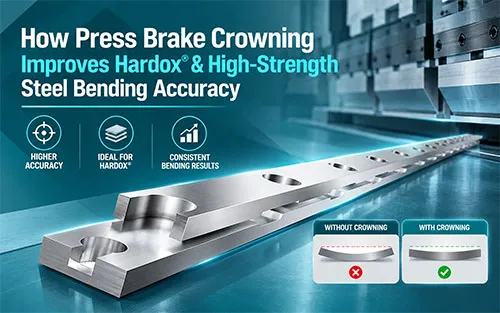
Without crowning:
──────\________/──────
With suitable compensation:
──────/‾‾‾‾‾‾‾‾\──────
The purpose is to counteract the elastic deformation produced by bending force.
The movement involved can be very small, which is why the mechanical accuracy, wedge geometry, drive resolution and machine calibration all matter.
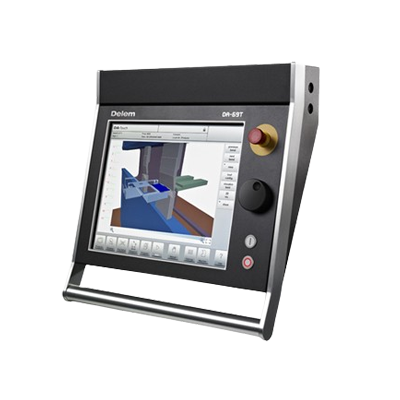
The DA-66T is particularly relevant for European-oriented press brakes.
Delem describes the DA-66T as a high-end 2D graphical press brake control with automatic bend-sequence calculation, collision detection and machine integration capabilities. Its published options specifically include “Advanced deflection systems — Frame deflection compensation.”
The DA-60 series is also based around Delem's modular Modusys architecture, allowing axes, I/O and additional machine functions to be integrated according to the press brake manufacturer's design.
Step 1 — Program the workpiece
The operator defines the bend and tooling.
Step 2 — Prepare the bending parameters
The CNC uses its configured machine/tool/material data to prepare the bend.
Step 3 — Apply the crowning value
The appropriate deflection-compensation function is included in the bending setup.
Step 4 — Command the machine interface
The controller communicates with the configured machine hardware.
Step 5 — Crowning mechanism moves
For an electric mechanical system, the drive moves the wedge mechanism to establish the required compensation.
Step 6 — Perform the bend
The crowning table counteracts the expected machine deflection.
This means the operator does not necessarily need to leave the CNC screen, walk to the compensation table and manually turn a handwheel between different production jobs.
A useful diagram for this article would be:
DA-66T CNC
↓
Bending Program
↓
Deflection Compensation Command
↓
OEM Machine Interface
↓
Servo / Motor Drive
↓
Mechanical Crowning Wedges
↓
Table Compensation
↓
More Consistent Angle Across the Bend
This is a much safer technical description than saying:
“DA-66T directly controls the crowning motor.”
The actual electrical implementation depends on the press brake manufacturer.
Cybelec follows the same overall concept: crowning becomes a coordinated machine function rather than a completely independent manual adjustment.
Cybelec has explicitly developed Dynamic Crowning Management for its control ecosystem. It announced this functionality for the VisiTouch Pac platform in 2023.
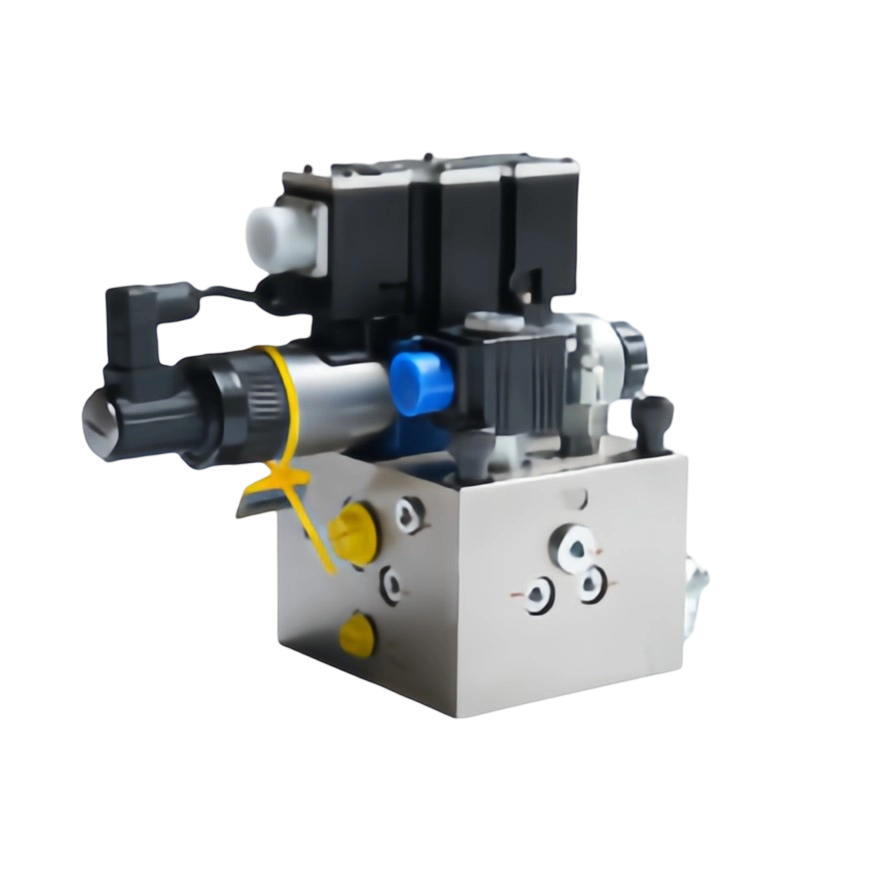
Its architecture can also support hydraulic crowning configurations. For example, Cybelec's CybVA 6 documentation describes channels for Y1/Y2, pressure and crowning proportional valves, with the CNC providing the relevant control references.
Therefore, depending on the press brake configuration, a Cybelec system may work with:
Mechanical CNC crowning
or
Hydraulic crowning
through the machine builder's configured control architecture.
Not necessarily.
This is important for customers purchasing a replacement or retrofit crowning system.
The mechanical compensation table and the CNC controller are related—but they are not the same component.
A crowning retrofit should be evaluated across three layers:
Layer | What Must Be Checked |
Mechanical | Table dimensions, mounting, load, wedge design, compensation stroke |
Electrical | Motor/servo, drive, encoder, limit/reference signals |
CNC | Controller support, I/O, axis configuration, OEM logic/interface |
So a customer should not simply order:
“One crowning table for DA-66T.”
Instead, the supplier should confirm the complete machine configuration.
This difference is especially important for European workshops with frequent job changes.
Feature | Manual Crowning | CNC Crowning |
Adjustment | Handwheel | CNC-controlled actuator |
Job change | Manual setup | Program-based |
Operator dependency | Higher | Lower |
Repeat jobs | Operator records setting | Setting can be integrated with program/configuration |
Frequent material changes | Less convenient | More efficient |
Long precision bending | Possible | Better suited to automated workflows |
Retrofit complexity | Lower | Higher |
Manual crowning is not inherently inaccurate.
For workshops producing a small range of repeat parts, it can still be practical.
The main advantage of CNC crowning is automation and repeatability, particularly when the workshop frequently changes material, thickness, tooling and bend length.
This is where CNC integration becomes valuable.
Imagine three jobs:
Job | Material | Thickness | Bend Length |
A | Mild Steel | 2 mm | 1000 mm |
B | Stainless Steel | 4 mm | 3000 mm |
C | High-Strength Steel | 6 mm | 4000 mm |
These jobs do not produce the same bending force.
Therefore, they do not necessarily produce the same press brake deflection.
A fixed compensation value is unlikely to be optimal for every condition.
A CNC-integrated system allows crowning to become part of the machine setup for each bending program.
This is particularly useful for workshops processing:
Mild Steel → Stainless Steel → Aluminum → Strenx® / Hardox®
through the same press brake.
This is another important point.
Installing a CNC crowning system does not automatically guarantee:
90.000° from left to right on every workpiece.
The controller can only produce good compensation when the entire system is properly configured.
Accuracy still depends on:
Machine geometry
Wedge accuracy
Tooling accuracy
Tool alignment
Material consistency
Y1/Y2 repeatability
Crowning calibration
Correct machine parameters
After installation or retrofit, the crowning system should therefore be calibrated against the actual press brake.
A practical calibration method is:
Use tooling with known geometry and consistent height.
Use a material and thickness representative of normal production.
Record the programmed Y position and crowning value.
Measure:
Left → 1/4 → Center → 3/4 → Right
If the center remains open, additional compensation may be required.
If the center is closed relative to the ends, compensation may be excessive.
Adjust according to the machine manufacturer's calibration procedure.
A good calibration should not be validated using only one thin sheet.
CNC crowning becomes especially attractive when your workshop has:
3–6 meter bending lengths
Frequent material changes
Stainless or high-strength steel
Small batch / high-mix production
Tight full-length angle tolerances
Frequent tooling changes
Delem or Cybelec high-end CNC controls
Experienced operators spending too much time on trial bends
The business benefit is not simply “higher accuracy.”
It is:
Less manual adjustment + Faster setup + Better repeatability + Fewer trial bends
Older press brakes can sometimes be upgraded from manual crowning—or no adjustable crowning—to CNC-controlled mechanical crowning.
But compatibility must be checked first.
Before ordering, provide:
1. Press brake brand and model
2. Machine tonnage
3. Bending length
4. Lower table dimensions
5. Existing crowning configuration
6. CNC model — e.g. DA-66T / DA-69T / Cybelec
7. Electrical cabinet information
8. Motor/drive configuration
9. Photos and drawings of the lower table
Do not select a crowning system based on the CNC brand alone.
The DA-66T supports machine integration and advanced frame-deflection compensation functions. The exact crowning implementation depends on how the press brake OEM configures the machine hardware, axes, I/O and control logic.
Delem supports deflection-compensation functionality within the press-brake control environment, but the actual calculation, configuration and actuation depend on the OEM machine implementation. Avoid assuming that every DA-66T-equipped machine has the same automatic crowning architecture.
Yes, depending on the system configuration. Cybelec documentation includes control architecture for crowning proportional valves, and Cybelec has also developed dynamic crowning-management functionality.
Potentially yes, but the mechanical table, drive system, electrical interface, CNC capabilities and available machine space must all be checked before retrofit.
Not automatically. Both can produce accurate compensation when properly designed and calibrated. CNC crowning mainly improves automation, repeatability and setup efficiency.
Not necessarily. If the left and right sides differ significantly, check Y1/Y2 synchronization, machine geometry and tooling alignment before using crowning to compensate.
 Selecting the Right Shearing Machine Blade: A Guide to Material Grades and Blade Gap OptimizationApril 22, 2026The shear is the “entry point” of the fabrication shop. If the initial cut is burred, twisted, or bowed, every subsequent process—from CNC punching to bending—will be inaccurate. MIHARTING shearin...view
 What Are the Differences in the Demand for Bending Machine Molds for New Energy Vehicles?June 26, 2025Compared with traditional vehicles, the demand for press brake toolings of new energy vehicles is significantly different, which is mainly reflected in the following aspects:1. Application of lightwei...view
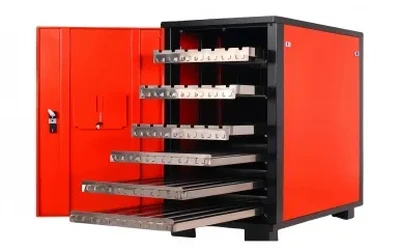 Why an Amada Press Brake Tooling Cabinet is an Investment in Tool Longevity (Not Just Storage)April 22, 2026Many shops spend $50,000 on high-precision Amada or European tooling, only to store them on wooden pallets or steel racks where the ground surfaces rub against each other. A single 0.05mm nick on a pu...view
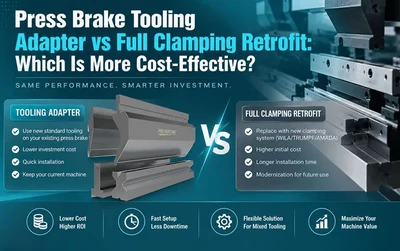 Press Brake Tooling Adapter vs Full Clamping Retrofit: Which Is More Cost-Effective?September 9, 2026Your press brake may still bend accurately after 10 or 15 years, but its tooling system can become a production bottleneck.This is common in European fabrication shops operating older machines with traditional European/Promecam or manufacturer-specific tooling interfaces.view
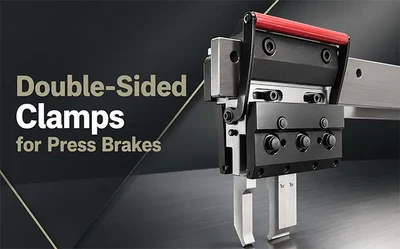 Double-Sided Clamps: The Smarter Way to Expand Press Brake Bending FlexibilityJune 23, 2026Discover how FAST double-sided clamps help press brake users achieve front and rear tool clamping, faster setup, safer operation, and lower tooling costs.view
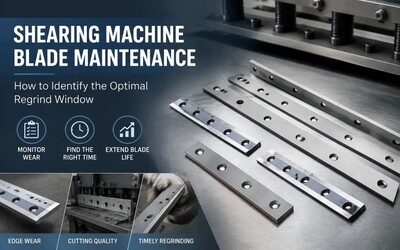 Shearing Machine Blade Maintenance: How to Identify the Optimal Regrind WindowSeptember 14, 2026The optimal regrind window for a shearing machine blade is the point where wear has started to reduce cutting performance but the blade still has enough material remaining for effective restoration. R...view