EN

A mobile sheet follower can support large panels on multiple press brakes, provided each machine is compatible. To choose the right system, check actual load conditions, machine connections, and changeover time.
You can share a mobile sheet follower between press brakes when its load, working height, controls, and safety interfaces suit each machine.
Check the complete bending sequence and request a load diagram. Then compare moving and setup time with the cost of dedicated units.
For a complete selection checklist, read our guide on how to choose a press brake sheet follower.
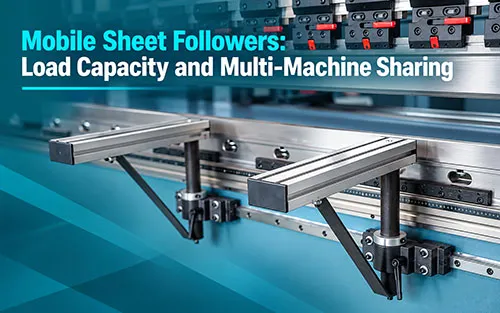
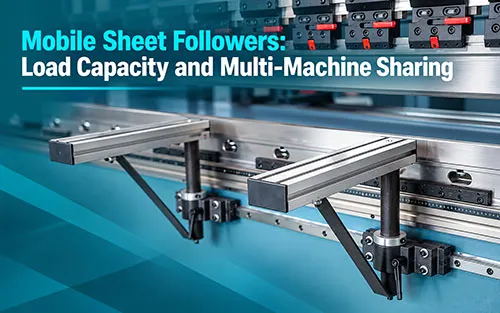
A mobile sheet follower supports the operator-side section of a panel as it moves during bending. Its movable design allows you to position it for use with compatible press brakes.
The follower’s movement must coordinate with the bending process. The method depends on the follower design and machine configuration.
Mobility can make one unit useful across several machines. Each installation still requires a compatibility review.
The stated load capacity is only the starting point. You also need to know where that load can be applied.
A panel extending farther from the follower creates a greater turning moment. Table extensions and changing support positions may also affect the permitted load.
Ask your supplier for a load diagram covering:
Rated load and its reference position.
Permitted panel overhang.
Support-table dimensions and extensions.
Operating and rotation limits.
Any restrictions for your selected configuration.
Do not select a follower by comparing its headline capacity with total sheet weight alone. Confirm the complete application with your supplier.
The same panel can create different support demands after it is rotated. The longest overhang and the greatest supported load may occur during different bends.
Review each bend using the actual part drawing and bending sequence. Pay particular attention to the panel’s centre of gravity and previously formed flanges.
Asymmetric parts need careful assessment. Their weight may not be distributed evenly between two supports.
Ask your supplier to assess the most demanding stage, including loading and unloading where relevant.
A mobile follower must be checked against each machine you plan to use. Similar-looking press brakes may have different working heights, tooling, controls, and safety arrangements.
Independent controls can reduce dependence on the press brake CNC. However, the follower still needs a suitable way to coordinate its movement with the machine.
Record the press brake control system and software version for each proposed installation.
Prepare a separate compatibility record for each press brake:
Check Item | Information to Record |
Machine | Manufacturer, model, working length, and installation location |
Controller | Model, software version, and available interfaces |
Tooling | Punches, dies, holders, and working heights |
Movement coordination | How the follower receives or responds to machine movement |
Safety integration | Required protective devices and stop behaviour |
Installation space | Operating position, clearance, and parking area |
Operating limits | Approved parts, load conditions, and adjustment settings |
A quick connector can make reconnection easier. It does not, by itself, confirm compatibility or safety integration.
A mobile system needs a practical route between machines. Measure doorways, aisles, floor transitions, and available turning space.
Check floor condition at each operating position. Ask how the follower is positioned, levelled, and secured before production.
Also reserve a parking location when the follower is not in use. Make sure it does not obstruct tooling changes, walkways, or material handling.
Moving the follower is only one part of changing machines. Your total changeover may include:
Preparing and moving the unit.
Positioning, levelling, and securing it.
Connecting the required interfaces.
Selecting the correct machine configuration.
Checking clearance and confirming operation.
Measure the full process during a trial or demonstration. Compare it with how often each press brake needs the follower.
If the unit moves several times per shift, setup time can reduce the value of sharing. If large-panel jobs are occasional, a shared unit may fit your workflow better.
Consideration | Shared Mobile Follower | Dedicated Followers |
Machine usage | Suitable when support is needed at different times | Suitable when machines frequently need support simultaneously |
Initial investment | One shared unit may reduce the number of units purchased | More units generally require a larger initial investment |
Changeover | Moving, connection, and verification are required | Less frequent relocation between machines |
Compatibility | Each machine must be approved for use | Each unit is configured for its assigned machine |
Production scheduling | Jobs must be coordinated around availability | Machines can operate independently |
Workshop layout | Requires suitable routes and parking space | Requires sufficient space at each machine |
Your choice depends on utilisation, simultaneous demand, and changeover time. Compare both arrangements using your actual production schedule.
Use representative parts on every approved press brake. An unloaded demonstration on one machine cannot confirm the complete shared setup.
During the test, check:
Support throughout the agreed bending sequence.
Working height and tooling clearance.
Load suitability at the actual support position.
Surface condition after bending.
Response to an interrupted cycle, as agreed with the integrator.
Time needed to move, reconnect, and verify the follower.
Access for loading, turning, and removing the part.
Record the approved settings and operating limits for each machine. Confirm training, maintenance instructions, and responsibilities before handover.
It may be possible when each machine has a compatible interface, working height, and safety arrangement. Ask the supplier to assess every machine before ordering.
The connection method depends on the follower design. Independent controls do not automatically mean the unit can operate without a suitable coordination method.
Confirm the required signals and operating conditions with the supplier.
No. Panel overhang, support position, centre of gravity, and table extensions can affect the required capacity.
Provide the complete bending sequence and ask for the applicable load diagram.
Changeover time depends on distance, floor conditions, connections, positioning, and verification. Measure the complete process for your workshop.
A shared unit may suit occasional use across compatible machines. Dedicated units may be more practical when both machines need support at the same time.
Compare actual operating hours, changeover time, and production schedules.
Provide your machine list, controller details, tooling heights, and workshop layout. Include representative part drawings, material, thickness, dimensions, and bending sequences.
Send MIHARTING Tooling your press brake list, panel drawings, and workshop layout. We can review load conditions, compatibility, and changeover requirements to help you compare shared and dedicated follower arrangements.
Request a Sheet Follower Application Review
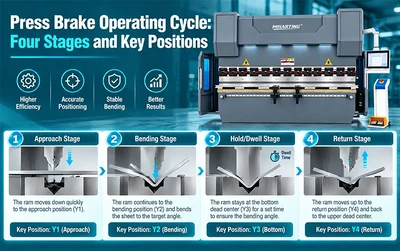 Press Brake Operating Cycle: Four Stages and Key PositionsOctober 6, 2026You need to understand the press brake operating cycle before diagnosing slow production or inconsistent bends. This guide explains four stages and the positions that connect them.view
 Functions of a Proportioning Valve in BrakesJanuary 8, 2026The brake tooling industry plays an essential role in vehicle safety, with the proportional valve being a critical component in the braking system. Understanding how this device functions can offer in...view
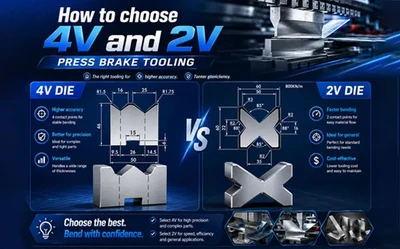 How to choose 4V and 2V press brake tooling?May 27, 2026How to choose 4V and 2V press brake tooling?What are their specific advantages,and for which applications are they best suited?This choice is a critical factor in determining your operational efficiency.We hope the following article will assist you in selecting the die best suited to your needs,thereby enhancing your production efficiency.view
 China Press Brake Tooling Manufacturer vs European SuppliersSeptember 4, 2026Compare China press brake tooling manufacturers with European suppliers in quality, compatibility, customization, lead time, service and total cost.view
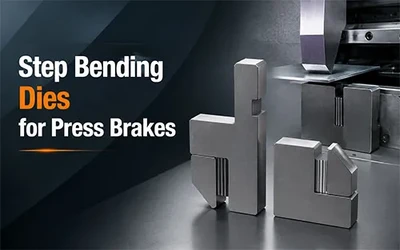 Step Bending Dies for Press BrakesAugust 4, 2026Discover Miharting step bending dies for press brakes, including DC01, DC02, and DC03 adjustable solutions. Improve offset bending accuracy, flexibility, and setup efficiency.view
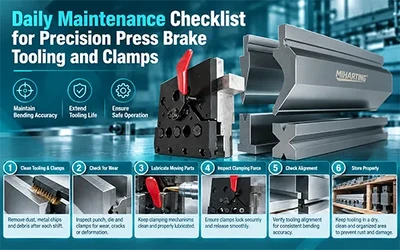 Daily Maintenance Checklist for Precision Press Brake Tooling and ClampsSeptember 29, 2026Precision tooling cannot maintain accurate bends if dirt, rust, wear, or loose components are ignored. A simple daily checklist helps you protect your tooling, clamps, bending accuracy, and production stability.view