EN
EN

Your press brake can have precise CNC control but still produce different angles across a long workpiece.
The right press brake crowning system helps you compensate for machine deflection and improve full-length bending accuracy.
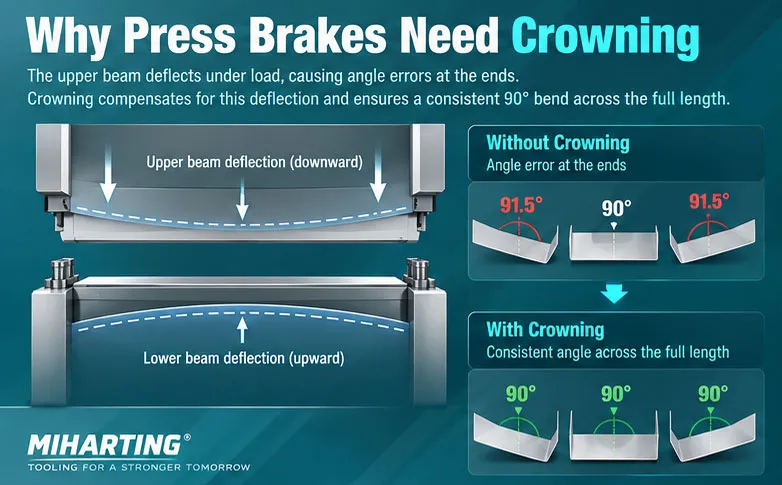
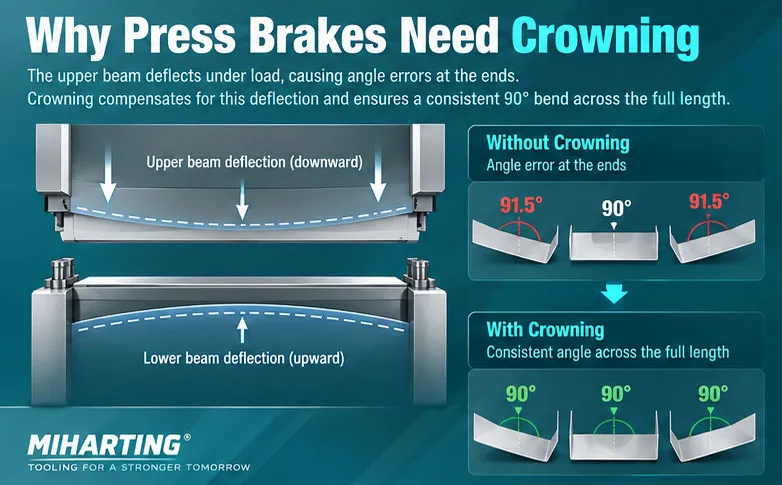
Every press brake deflects slightly under bending force.
The ram and lower beam experience elastic deformation as bending force increases. The center may receive less effective punch penetration.
You may then see:
90.0° Left → 91.5° Center → 90.1° Right
This problem becomes more noticeable with longer workpieces and higher bending forces.
A press brake crowning system creates controlled counter-deflection. You can use it to improve punch penetration consistency along the bending length.
Crowning does not simply change bending depth. It corrects how compensation is distributed along the machine
Do not increase crowning whenever you see an incorrect angle.
You should first identify the error pattern.
Bending Result | Check First |
Center more open than both ends | Insufficient crowning |
Center more closed than both ends | Excessive crowning |
Entire part too open | Y-axis depth or springback |
Left and right angles differ | Y1/Y2 or machine alignment |
One local area is incorrect | Tooling or local compensation |
Results change between batches | Material variation |
This diagnosis prevents you from compensating for the wrong problem.
A crowning system creates a controlled compensation curve along the press brake table.
The curve counteracts the elastic deformation produced during bending.
The principle is simple:
Bending Force
↓
Ram and Bed Deflection
↓
Uneven Tool Penetration
↓
Crowning Compensation
↓
More Uniform Tool Penetration
↓
More Consistent Bend Angles
The actual compensation method depends on your machine design.
You will mainly encounter mechanical and hydraulic crowning when designing a modern press brake.
They achieve similar goals through different mechanisms.
Feature | Mechanical Crowning | Hydraulic Crowning |
Compensation method | Precision wedges | Hydraulic pressure |
Main location | Lower table/tool holder | Lower beam |
Adjustment | Manual or motorized | Hydraulic control |
CNC integration | Available | Available |
Local adjustment | Possible by design | Depends on machine design |
Maintenance | Mainly mechanical | Hydraulic components involved |
Retrofit potential | Often practical | More machine-dependent |
Typical use | New machines and retrofits | Integrated press brake designs |
You should not select a system by technology name alone.
Your machine structure and target application matter more.
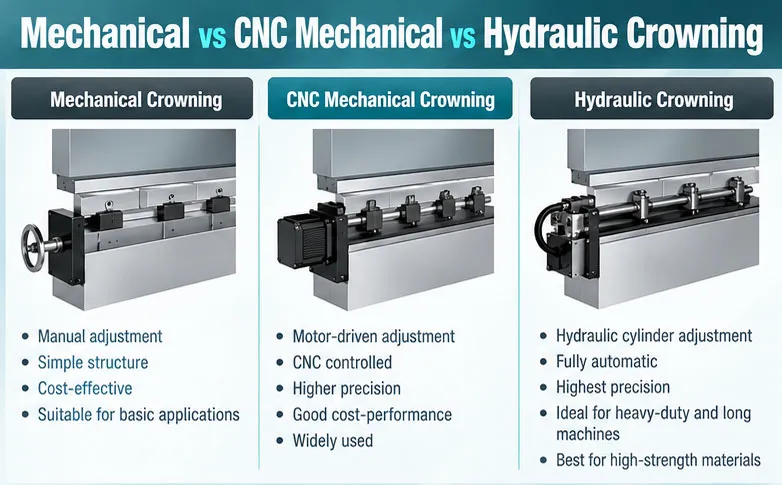
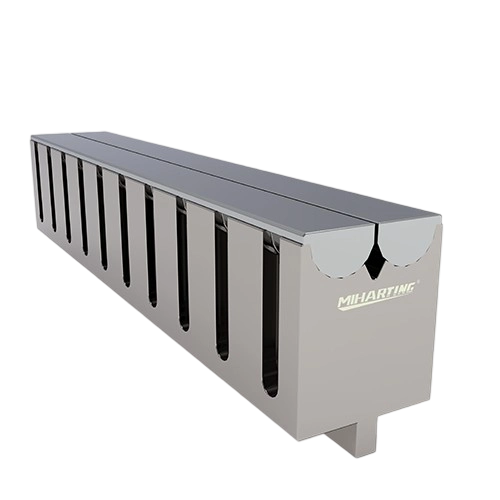
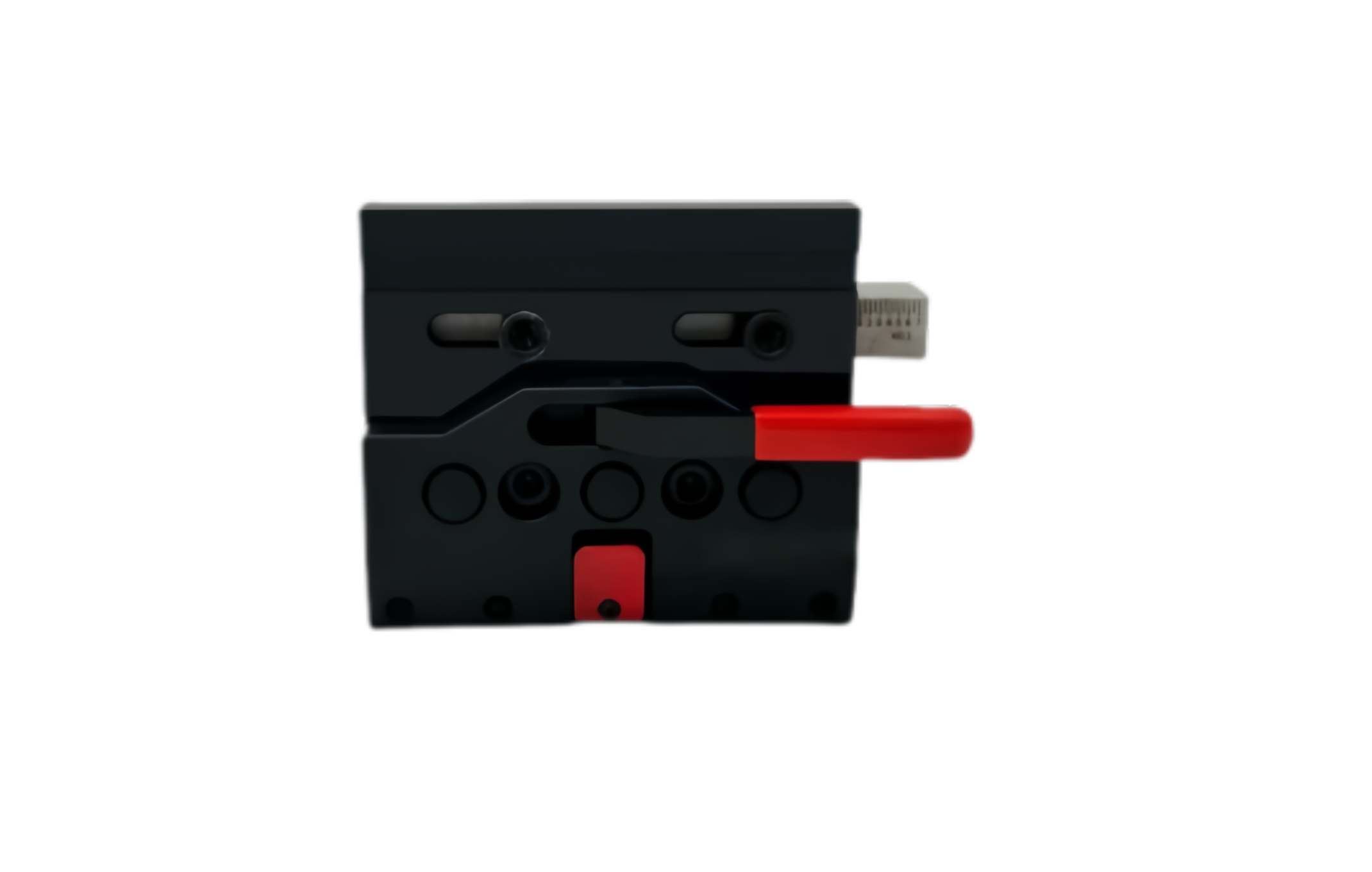
A manual mechanical crowning system uses a handwheel or similar mechanism to move precision wedges.
You can consider it for simpler press brakes.
It works well when your customers produce repeat parts with limited material changes.
You get a relatively simple structure.
Installation and maintenance can also remain straightforward.
The main limitation is operator involvement.
When material or bending conditions change frequently, your operator must adjust the compensation again.
A motorized mechanism moves the precision wedges according to the configured compensation command.
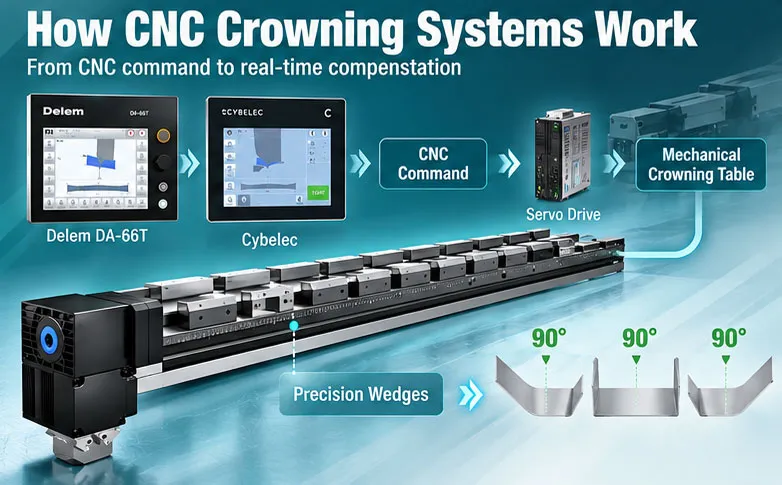
A typical control chain is:
CNC Controller → Command → Drive → Motor → Precision Wedges → Compensation Curve
This reduces manual intervention during frequent job changes.
You can also integrate crowning more closely with the bending program.
For an OEM, this creates a stronger machine configuration for demanding customers.
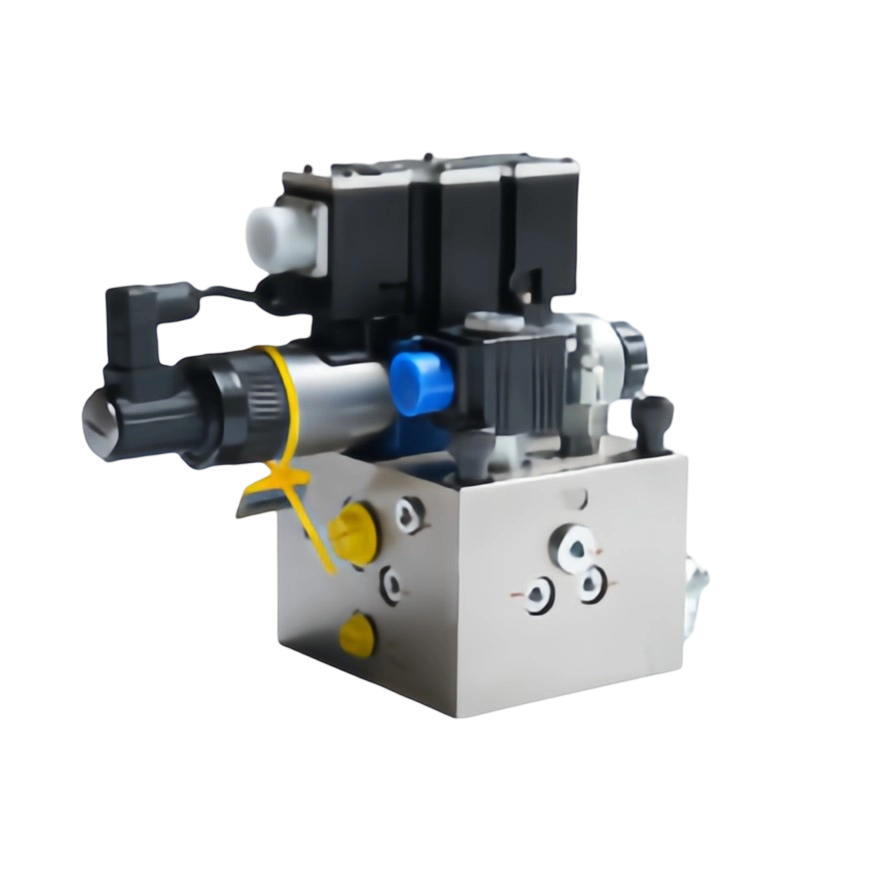
Hydraulic crowning uses hydraulic elements to compensate for lower-beam deformation.
It can be highly effective when designed as part of the complete machine structure.
You should consider the hydraulic circuit, control architecture and maintenance requirements during machine development.
For a retrofit, hydraulic crowning may require more structural integration than a mechanical crowning table.
That is why mechanical systems are often attractive for upgrade projects.
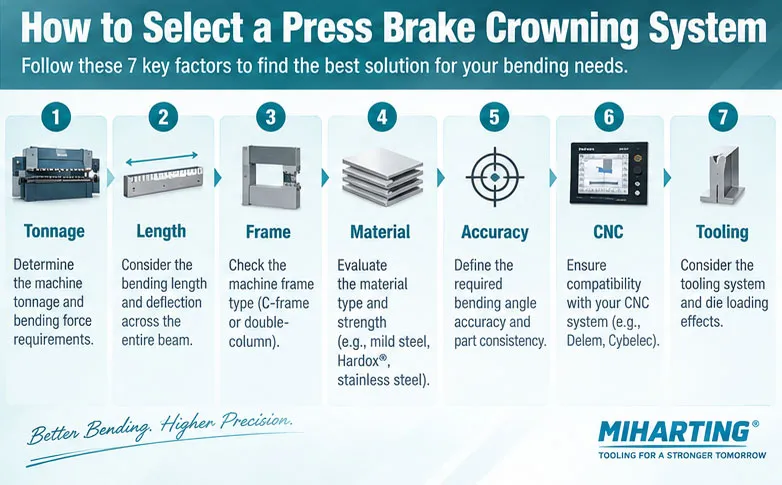
As a press brake manufacturer, you should start with the machine rather than the crowning table.
The following seven factors matter most.
Higher bending forces can produce greater machine deflection.
Your crowning system must also withstand the intended working load.
Never choose a compensation table only by bending length.
A 1600 mm press brake and a 6000 mm press brake have very different compensation requirements.
Longer machines require careful control of the compensation curve.
You should evaluate the complete deflection profile instead of only the center position.
Two 3200 mm press brakes can show different deflection behavior.
Frame geometry, beam dimensions and structural stiffness all affect the final deformation curve.
Your press brake crowning system should therefore match the actual machine structure.
Ask what your customer will bend.
A machine processing thin mild steel has different demands from one bending thick stainless steel or high-strength steel.
Higher bending forces make correct deflection compensation increasingly important.
Not every press brake needs the same compensation configuration.
A basic workshop machine may prioritize simplicity and cost.
A precision machine may prioritize automatic adjustment and repeatability.
Match the crowning specification to the machine's real accuracy target.
If you want automatic crowning, confirm the control architecture early.
Your controller and OEM electrical design must support the intended compensation function.
For example, a system may use:
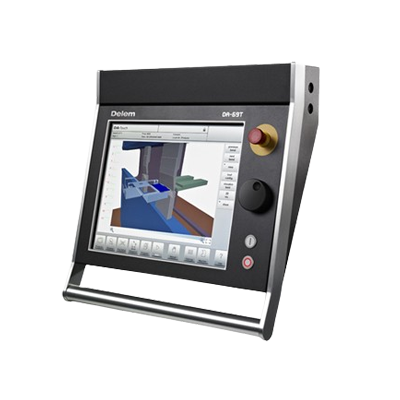
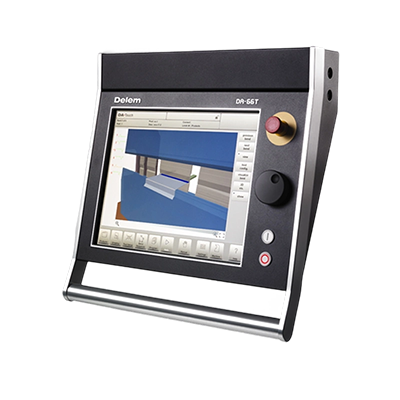
Delem / Cybelec CNC → OEM Interface → Drive → Motor → Mechanical Crowning
Do not assume the controller directly operates every crowning system.
The exact integration depends on your electrical architecture.
Crowning cannot compensate for poor tooling installation.
Your punch, die, tool holder and crowning table must work as one system.
Check:
Working height + Tool interface + Alignment + Load capacity + Clamping method
A high-precision crowning table cannot correct a damaged or poorly aligned tool.
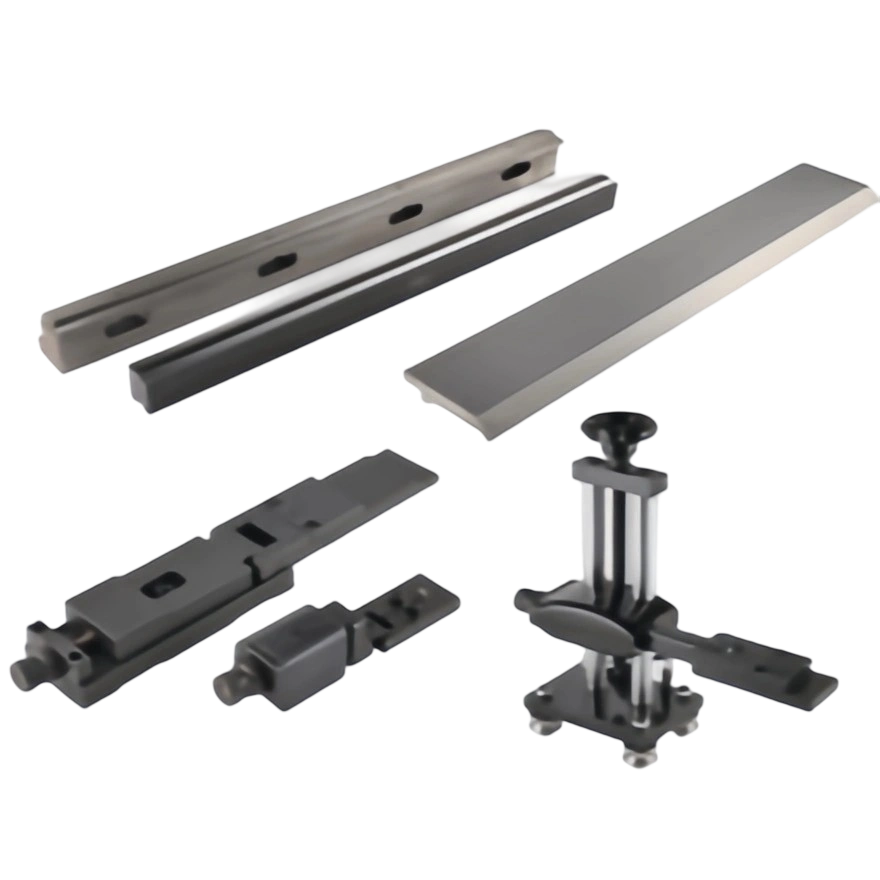
The wedge system is the heart of mechanical crowning.
When the wedges move horizontally, their geometry produces controlled vertical displacement.
Small wedge movements can create fine changes in the compensation curve.
For machine manufacturers, you should evaluate:
Wedge machining accuracy
Surface quality
Drive repeatability
Structural rigidity
Adjustment range
Local adjustment capability
Do not judge a crowning table only by its external appearance.
Its internal geometry determines how consistently it can create the required compensation curve.
Real press brakes do not always deflect according to one perfect theoretical curve.
Machining tolerances, assembly and tooling can create local deviations.
A crowning system with suitable local adjustment can help you fine-tune individual areas.
This becomes especially valuable on 4-meter and longer machines.
Your goal is not simply:
“Raise the center.”
Your goal is:
“Match the compensation curve to the actual machine deflection.”
Manual compensation depends heavily on operator experience.
One operator may use a setting of 2.5.
Another may choose 3.0 for the same job.
CNC integration can make the process more repeatable.
A typical workflow becomes:
Select Program
→ Load Material and Tool Data
→ Apply Crowning Command
→ Position Compensation System
→ Perform Bend
→ Fine-Tune if Required
You can then save the proven settings for repeat production.
This is especially useful for high-mix manufacturing.
This is a common technical mistake.
Crowning and springback compensation solve different problems.
You use crowning to compensate for machine deflection along the bending length.
You use overbending and suitable process parameters to compensate for material springback.
Consider these two patterns:
92° → 92° → 92°
You should investigate overall bending depth and springback.
90° → 92° → 90°
You should investigate machine deflection and crowning.
Correct diagnosis prevents unnecessary machine adjustment.
Do not evaluate the system from one measurement point.
Use a long test workpiece and measure several positions.
For example:
Left → 1/4 → Center → 3/4 → Right
Record the angle at every position.
Then compare the result before and after compensation.
90.1° → 90.8° → 91.6° → 90.9° → 90.2°
90.1° → 90.0° → 90.1° → 90.0° → 90.1°
These values are illustrative.
Your actual result depends on the machine, material, tooling and measurement method.
Length is not enough.
You also need tonnage, load distribution and machine geometry.
The crowning table is part of the force path.
You must confirm its rated capacity.
Crowning cannot solve every Y1/Y2, tooling or material problem.
Diagnose first.
Automatic movement does not guarantee accurate compensation.
You still need machine-specific calibration.
Poor tooling alignment can create errors that look like crowning problems.
Inspect the complete bending system.
If you manufacture press brakes, provide complete machine information before ordering.
Required Information | Why It Matters |
Machine tonnage | Determines load requirements |
Bending length | Determines crowning length |
Lower table dimensions | Confirms installation interface |
Machine frame design | Helps evaluate deflection behavior |
CNC controller | Determines integration requirements |
Manual or CNC control | Determines drive configuration |
Tooling system | Confirms interface and working height |
Target materials | Helps define working conditions |
Accuracy requirement | Helps select system configuration |
For retrofit projects, also provide drawings and clear photos of the existing lower table.
A press brake crowning system compensates for elastic machine deflection during bending. It helps maintain more consistent tool penetration across the bending length.
Not every application requires the same level of compensation. Crowning becomes more important for long bends, higher forces and tighter angle tolerances.
Neither is universally better. You should choose according to machine structure, control requirements, maintenance strategy and customer application.
Yes, suitable CNC mechanical systems can be integrated into press brakes using these controllers. The exact interface depends on your OEM control architecture.
Often yes, especially with mechanical crowning systems. You must first check table dimensions, load, working height and control compatibility.
No. Final accuracy also depends on machine geometry, tooling, material, Y-axis repeatability and correct calibration.
Crowning can compensate for machine deflection caused by high bending loads. It does not directly eliminate material springback.
The best press brake crowning system is not simply the most automated option.
You need a system that matches your machine structure, bending force, working length, tooling and CNC architecture.
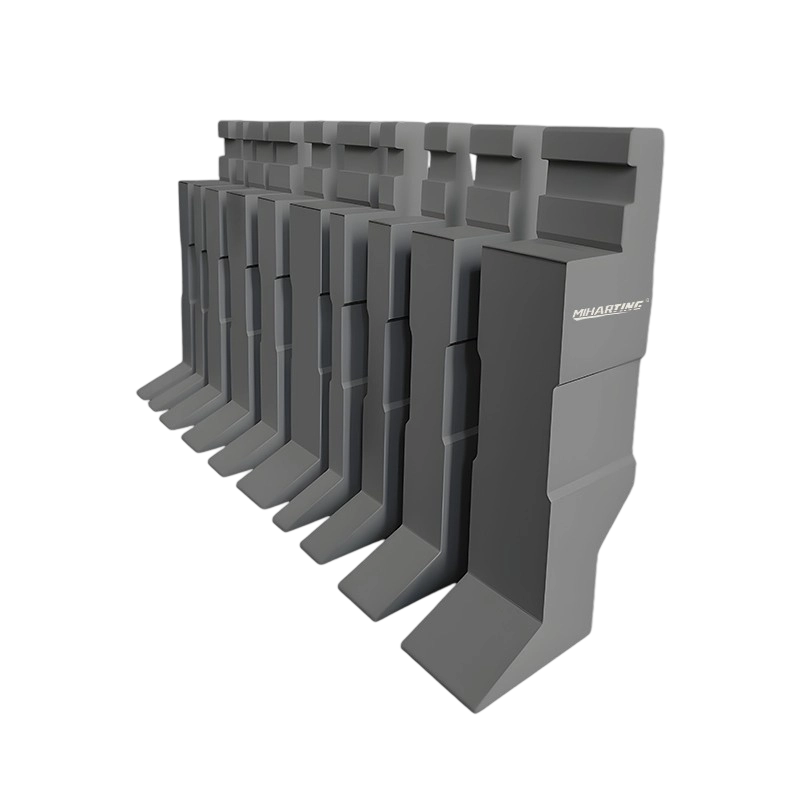
Miharting provides manual and CNC mechanical crowning solutions for press brake manufacturers and retrofit projects. Send us your machine drawing and technical requirements, and we can help you configure the right compensation system.
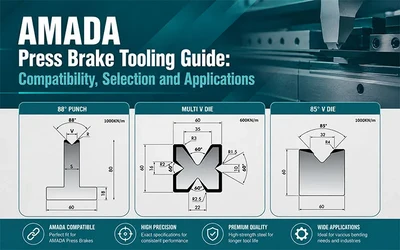 AMADA Press Brake Tooling Guide: Compatibility, Selection and ApplicationsAugust 31, 2026This guide looks at AMADA press brake tooling from a practical production perspective: how to identify the right tooling, how to select it for different applications, and when standard tooling should be replaced by a specialized solution.view
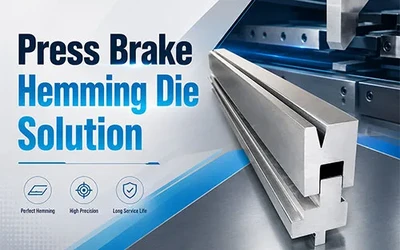 Press Brake Hemming Die Solution for Safer and Stronger Sheet Metal EdgesAugust 17, 2026A press brake hemming die, also known as a sheet metal hemming die or flattening die, is an effective tooling solution for this problem. By folding and flattening the edge of the sheet metal, the die helps create a smooth, safe, and reinforced edge. This process is widely used for electrical cabinets, machine covers, enclosures, doors, panels, trays, home appliance parts, elevator components, and other precision sheet metal products.view
 Press Brake Tooling Guide 2026: Types, Materials, Selection & Maintenance TipsAugust 10, 2026Press brake tooling plays a critical role in sheet metal bending performance. Although the press brake machine provides the bending force, the tooling determines the final bending accuracy, surface quality, production efficiency, and tool life.view
 What Is Press Brake Tooling and How Does It Work?January 8, 2026In the world of metal fabrication, press brake tooling stands as a cornerstone of efficiency and precision, crucial for bending operations in various industries. Understanding the complex orchestratio...view
 Press Brake Tooling Maintenance: How to Extend Tool LifeJune 8, 2026Learn practical press brake tooling maintenance tips to extend tool life, reduce bending defects, improve accuracy, and lower tooling replacement costs.view
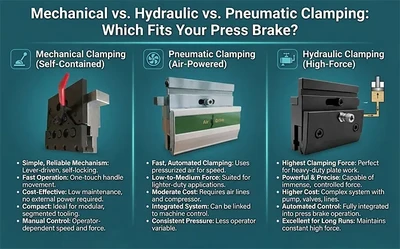 Mechanical vs. Hydraulic vs. Pneumatic Clamping: Which Fits Your Press Brake?September 8, 2026Choosing a press brake quick clamping system is not simply about finding the fastest option.Mechanical, pneumatic and hydraulic clamping systems each have different advantages.The right choice depends on your tooling, production volume, tool-change frequency and machine configuration.view