EN
EN

Hardox and Strenx are designed to provide high strength, wear resistance or structural performance.
Those properties also change the bending process.
Compared with conventional mild steel, operators need to pay closer attention to:
Higher bending force
Greater springback
Larger recommended punch radii
Die opening
Rolling direction
Machine capacity
Press brake deflection
SSAB states that bending force, springback and generally the minimum recommended punch radius increase with steel strength.
This means simply loading a Hardox plate and using the same setup as conventional mild steel is not a reliable bending strategy.
The difference can be significant.
SSAB publishes calculated examples for bending several of its grades to a final 90° angle under specified recommended conditions:
SSAB Steel | Thickness | Reference Bending Force | Calculated Springback |
Domex® 355MC | 10 mm | 630 kN/m | 3.9° |
Strenx® 700MC | 10 mm | 1170 kN/m | 6.9° |
Strenx® 1100E | 10 mm | 1340 kN/m | 16.3° |
Hardox® 450 | 10 mm | 1380 kN/m | 16.6° |
Hardox® 500 Tuf | 10 mm | 1570 kN/m | 19.0° |
These are SSAB reference calculations for specific bending conditions, not universal values for every press brake setup. Actual results depend on material grade, thickness, rolling direction, die width, punch radius and tooling configuration.
But the trend is important.
At the same 10 mm thickness, the published reference force for Hardox 500 Tuf is approximately 2.5 times that shown for Domex 355MC.
That additional force matters not only to the steel.
It matters to the press brake.
Every press brake undergoes some elastic deformation under load.
During bending:
Ram ↓
Punch ↓
High-Strength Plate
Die ↑
Bed ↑
The machine frame resists the bending load, but the ram and bed are not infinitely rigid.
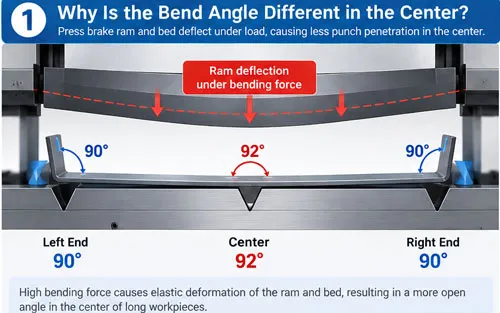
As bending force increases, elastic deflection can become more significant. SSAB specifically notes that higher bending force can increase deflection of the upper and lower press-brake elements. Without correction, the resulting longitudinal gap can cause different bend angles along the workpiece.
This is where crowning becomes important.
Imagine bending a long Hardox plate.
Your first measurement shows:
Position | Finished Angle |
Left | 90.1° |
Center | 92.0° |
Right | 90.2° |
The first reaction might be:
“Hardox has too much springback.”
But that does not fully explain this measurement pattern.
If springback alone were responsible, you would normally investigate the overall bending result.
When the ends are close to target but the center is significantly more open, machine deflection should also be investigated.
92° – 92° – 92°
→ investigate overall springback / bending depth.
90° – 92° – 90°
→ investigate press brake deflection / crowning.
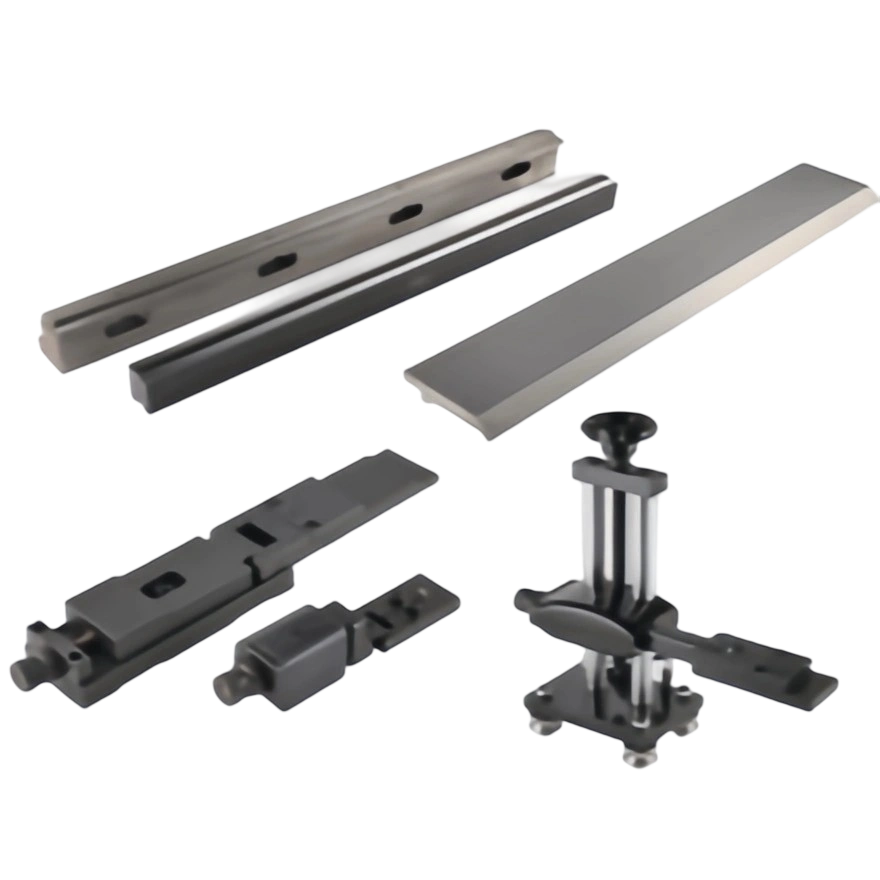
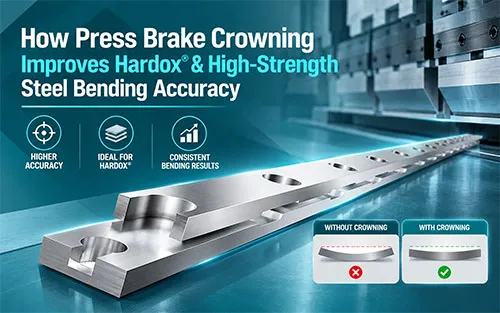
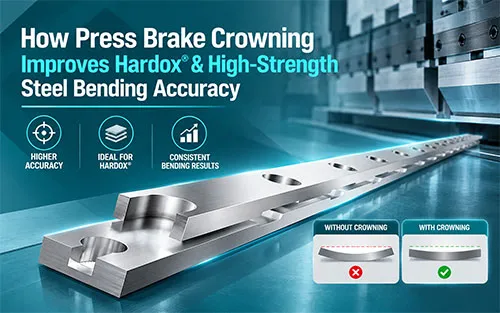
A press brake crowning system deliberately creates a controlled compensation curve along the lower beam or tooling reference.
For a mechanical crowning system, precision wedges are positioned along the bending length.
As the wedges move, they generate a very small vertical compensation profile.
The principle is:
High Bending Force
↓
Ram & Bed Deflection
↓
Center Receives Less Effective Penetration
↓
Crowning Creates Counter-Deflection
↓
More Uniform Punch Penetration
↓
More Consistent Bend Angle
SSAB describes crowning as intentionally compensating for deflection so that material bends more uniformly across its length.
This distinction is important for technical credibility.
Suppose a Hardox workpiece springs back significantly after unloading.
Increasing crowning is not the correct way to solve the overall springback.
Springback is influenced by factors including:
Yield strength
Punch radius
Die width
Material strain hardening
Tool configuration
SSAB states that springback increases with steel strength and with the die-width-to-thickness ratio, and recommends tooling that allows sufficient overbending.
Therefore:
Problem | Main Correction |
Entire workpiece too open | Overbending / Y-depth / springback compensation |
Center more open than ends | Crowning |
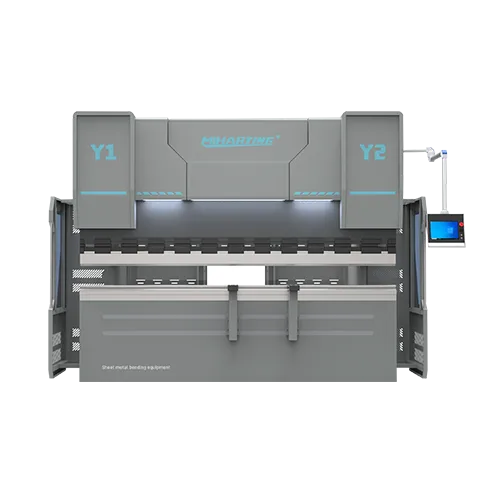
Left/right angles different | Y1/Y2 / alignment |
Local angle variation | Tooling / local compensation |
Cracking at bend | Punch radius / rolling direction / material setup |
This table is worth putting prominently in the article.
For long Hardox and Strenx parts, a modern CNC mechanical crowning system provides a practical way to control machine deflection.
Multiple wedges distribute compensation across the bending length rather than correcting only one point.
On motorized systems, the crowning value can be controlled according to the bending program.
This is especially useful when a workshop frequently switches between:
Mild Steel → Stainless Steel → Strenx → Hardox
because the required bending forces and compensation values can differ substantially.
Depending on the crowning design, individual sections can be calibrated to correct local machine or tooling deviations.
Once a successful combination of material, tooling, Y position and crowning value has been established, it can be recorded for repeat jobs.
High-strength steel places considerably higher loads on punches, dies, clamps and crowning systems.
Before bending, verify:
Press brake tonnage
Punch maximum load
Die maximum load
Crowning system load capacity
Tool holder / clamp capacity
V-die opening
Minimum punch radius
Do not calculate the required tonnage using a mild-steel chart and assume it applies unchanged to Hardox.
SSAB's bending-force guidance specifically includes tensile strength, plate thickness, bend length, die width and tooling geometry among the factors affecting required force.
Crowning is only one part of successful high-strength steel bending.
SSAB emphasizes that bending performance can differ depending on whether the bend is made longitudinally or transversely to the rolling direction, and its recommendations specify minimum punch-radius relationships accordingly.
For high-strength steel, always verify:
Steel grade
Actual thickness
Rolling direction
Recommended minimum punch radius
V opening
Required bending force
Tooling capacity
Crowning value
Skipping one of these can turn what appears to be a crowning problem into a tooling or material problem.
Don't program simply for “high-strength steel.”
Hardox 450, Hardox 500 Tuf and Strenx 700 do not behave identically.
Determine the appropriate punch radius, V opening, force and expected springback.
SSAB provides its BendCalc bending calculator for its own steel products.
Check the load rating of every component in the force path.
Measure:
Left → Center → Right
Don't measure only the center.
If all three positions are similarly open, adjust the bending process for springback.
If the center differs significantly from both ends, investigate crowning.
Adjust compensation gradually until the full-length angle becomes more consistent.
Record:
Grade + Thickness + Punch + Die + Y Position + Crowning Value
This creates a reusable bending recipe for future batches.
Symptom | Possible Cause | Check |
Entire bend too open | High springback | Overbend / Y depth |
Center too open | Machine deflection | Crowning |
Center too closed | Excessive compensation | Reduce crowning |
Left/right different | Machine synchronization | Y1/Y2 |
Bend cracks | Radius/setup/material direction | Punch radius & rolling direction |
Angle changes between batches | Material variation | Grade/properties/thickness |
Tool damage | Excessive load | Force & tooling capacity |
This is the section that makes the article genuinely useful to an operator rather than simply SEO content.
Not automatically in every application. However, high-strength steel can require substantially higher bending force, and greater force can increase machine deflection. For long parts, this may require more crowning compensation than a lower-force mild-steel job.
Crowning primarily compensates for press brake deflection. Material springback should be handled through correct tooling, overbending and process parameters.
This pattern is consistent with insufficient compensation for machine deflection. Check tooling alignment and press brake condition, then evaluate the crowning setting.
Tooling must allow sufficient overbending to compensate for springback. SSAB specifically notes that a 90° die cannot produce a final 90° high-strength-steel bend when the necessary overbending is prevented by the die geometry.
Use the exact material grade, thickness, bend length, die geometry and tensile properties rather than a generic mild-steel tonnage chart. For genuine SSAB products, BendCalc provides reference calculations for bending force, springback, punch depth and related parameters.
Hardox and other high-strength steels create a more demanding bending environment because higher material strength increases both springback and required forming force.
But these produce two different problems:
Springback changes the final angle after unloading.
Higher bending force can increase press brake deflection and create different angles along the bending length.
That is why accurate long-part high-strength-steel bending requires more than simply adding tonnage.
The complete process is:
Correct Material Data
→ Correct Punch Radius
→ Correct V Opening
→ Springback Compensation
→ Adequate Tooling Capacity
→ Precision Crowning
→ Full-Length Angle Verification
For European workshops bending long Hardox, Strenx and other high-tensile components, a properly configured mechanical or CNC crowning system can therefore be an important part of maintaining consistent angles from one end of the workpiece to the other.
 How Amada AFH Tooling Revolutionizes Setup Times in Precision Sheet Metal BendingApril 22, 2026In a world of “Just-in-Time” manufacturing, the longest part of the bending process is no longer the bend itself—it’s the setup. Amada AFH (Amada Fixed Height) tooling was designed to solve this. ...view
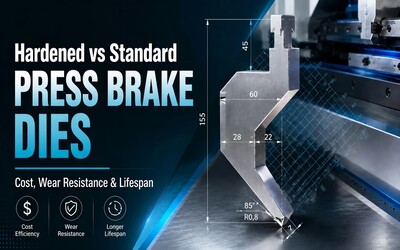 Hardened vs Standard Bystronic Press Brake Dies: Cost, Wear Resistance, and Lifespan ComparisonSeptember 14, 2026Hardened and standard Bystronic press brake dies are designed for different production requirements. Hardened dies are the preferred choice for manufacturers requiring longer tooling lifespan, improve...view
 Golden Rules of Press Brake OperationJanuary 8, 2026Operating a press brake efficiently and safely requires expertise, vigilance, and adherence to best practices. As essential machinery in the realm of sheet metal fabrication, press brakes shape and fo...view
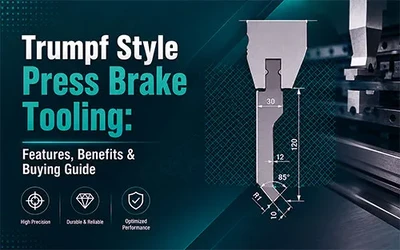 Trumpf Style Press Brake Tooling: Features, Benefits & Buying GuideAugust 27, 2026For manufacturers using high-end CNC press brakes or quick-change clamping systems, Trumpf style press brake tooling has become a preferred choice for precision bending, fast setup, and stable long-term production.view
 Amada Press Brake Tooling Compatibility GuideJune 18, 2026Learn how to choose compatible Amada press brake tooling for European machines. Avoid wrong interfaces, poor fit, and short tool life with 42CrMo, HRC 48-52, full length heat treatment tooling.view
 China Press Brake Tooling Manufacturer vs European SuppliersSeptember 4, 2026Compare China press brake tooling manufacturers with European suppliers in quality, compatibility, customization, lead time, service and total cost.view