EN
EN

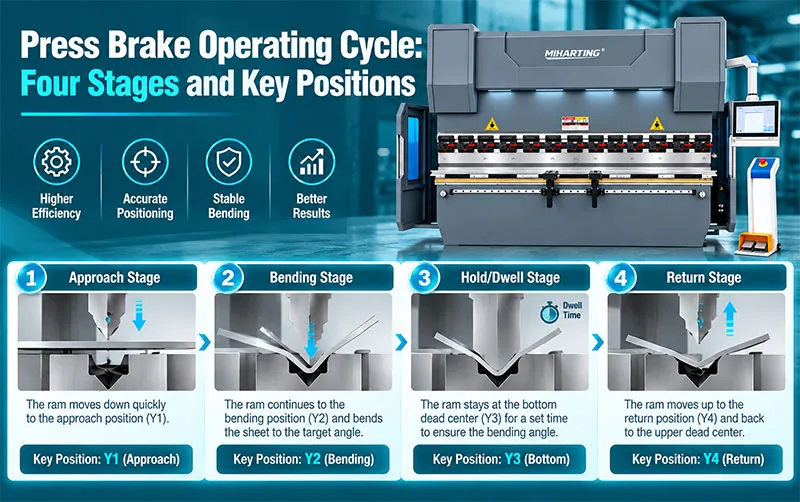
Selecting the correct press brake die opening is crucial; the size of the V-opening affects bending accuracy, the inner bend radius, bending force, surface quality, and more.
If the V-opening is too small, the bending force increases, potentially damaging the material surface; if the V-opening is too large, the bending radius increases, reducing bending accuracy. This article will help you select the appropriate V-die opening for your bending machine.
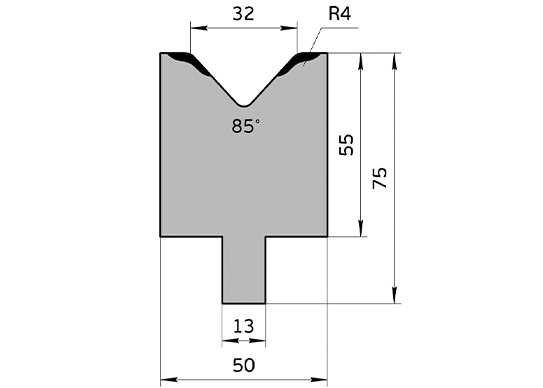
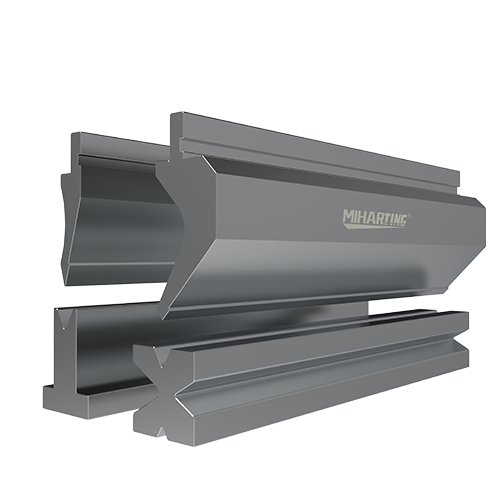
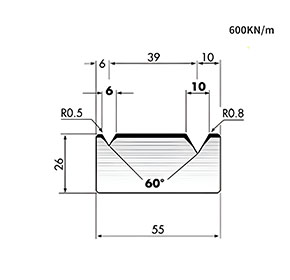
The die opening—also known as the V-opening—refers to the width of the V-shaped groove in the press brake's bottom die. During the bending process, the upper die presses the sheet metal into this V-shaped groove to achieve the desired bending angle.
In air bending, the sheet does not fully bottom out in the die; therefore, the size of the V-opening plays a crucial role in determining the bend radius and bending force.
For most air bending applications, the V opening is selected according to the material thickness.
A common rule is:
V opening = 6 to 8 × material thickness
For example, if the sheet thickness is 3 mm:
V = 3 mm × 8 = 24 mm
So a 24 mm V die opening is commonly used.
Material Thickness | Recommended V Opening |
0.5 - 2 mm | 6 × thickness |
2 - 6 mm | 8 × thickness |
6 - 12 mm | 10 × thickness |
Above 12 mm | 10 - 12 × thickness |
These values are general recommendations for air bending. The final choice should also consider material type, bending radius requirements, machine tonnage, and product accuracy.
The basic formula is:
V = K × T
Where:
V = die opening
K = bending factor, usually 6, 8, 10, or 12
T = material thickness
Example:
Material thickness: 4 mm
Recommended factor: 8
V opening = 4 × 8 = 32 mm
So, for 4 mm mild steel, a 32 mm V opening is usually a good starting point.
In air bending, the inside bend radius is closely related to the V opening. A larger V opening creates a larger inside radius, while a smaller V opening creates a smaller inside radius.
A practical estimate is:
Inside radius ≈ 0.16 × V opening
Example:
V opening = 32 mm
Inside radius ≈ 0.16 × 32 = 5.12 mm
This means if the drawing requires a very small inside radius, you may need a smaller V opening or a different bending method. However, using a very small V opening will increase tonnage and may damage the material.
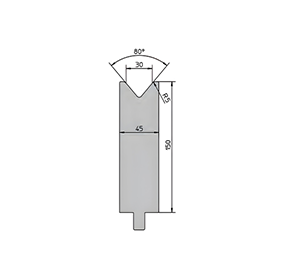
The smaller the V opening, the higher the bending force required. This is why choosing the correct die opening is also important for protecting the press brake machine and tooling.
A simplified air bending force formula is:
P = 1.42 × Rm × T² / V
Where:
P = bending force in kN/m
Rm = tensile strength in N/mm²
T = material thickness in mm
V = die opening in mm
For mild steel, Rm is commonly around 400 - 450 N/mm².
Example:
Material: mild steel
Thickness: 6 mm
Tensile strength: 450 N/mm²
V opening: 48 mm

P = 1.42 × 450 × 6² / 48
P ≈ 479 kN/m
This is about 49 tons per meter.
Different materials need different V opening choices.
Mild Steel
Usually use 6T to 8T for normal air bending.
Stainless Steel
Stainless steel has higher tensile strength, so it needs more bending force. A larger V opening, such as 8T to 10T, is often preferred.
Aluminum
Aluminum is softer, but it can crack if the bend radius is too small. A 6T to 8T V opening is commonly used depending on alloy and hardness.
High-strength Steel
Use a larger V opening to reduce bending force and avoid cracking. Always check the material’s minimum bend radius.
Start with 8 × material thickness for common air bending.
Use a larger V opening for thick plate or high-strength materials.
Use a smaller V opening only when a smaller bend radius is required.
Check whether the required tonnage is within the press brake capacity.
Make sure the flange length is large enough to rest on the die shoulders.
For stainless steel, calculate bending force carefully because tonnage is higher.
Test bend first when working with new material or tight tolerance parts.
Thickness | Common V Opening | Approx. Inside Radius |
1 mm | 6 - 8 mm | 1.0 - 1.3 mm |
2 mm | 12 - 16 mm | 1.9 - 2.6 mm |
3 mm | 18 - 24 mm | 2.9 - 3.8 mm |
4 mm | 32 mm | 5.1 mm |
6 mm | 48 mm | 7.7 mm |
10 mm | 80 - 100 mm | 12.8 - 16 mm |
Selecting the appropriate V-opening size for the press brake die helps ensure consistent bending quality and accurate angles, achieves the correct bend radius, and guarantees safe equipment operation. Generally, the V-opening size can be set to 6 to 8 times the material thickness; however, a larger V-opening is required for thick plates, stainless steel, or high-strength materials.
If you wish to improve bending efficiency, reduce tool wear, and produce high-quality sheet metal parts, please contact us.
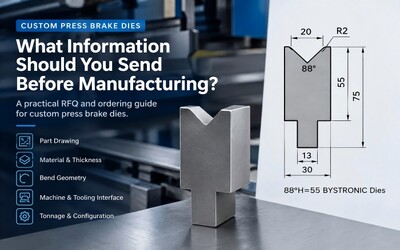 Custom Press Brake Dies: What Information Should You Send Before Manufacturing?September 18, 2026Custom Press Brake Dies: What Information Should You Send Before Manufacturing? | MIHARTINGOrdering a custom press brake die often starts with a straightforward request: a customer has a part that can...view
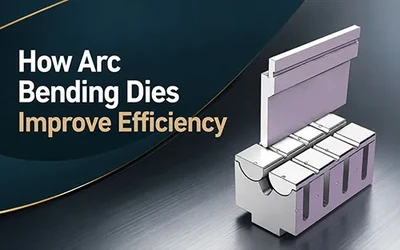 How Arc Bending Dies Improve EfficiencyJuly 29, 2026Arc bending dies can meet a wide range of bending radius requirements by simply changing the die head. This article explains the arc bending solution, die structure, advantages, and selection tips for efficient sheet metal forming.view
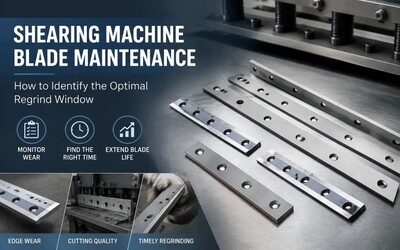 Shearing Machine Blade Maintenance: How to Identify the Optimal Regrind WindowSeptember 14, 2026The optimal regrind window for a shearing machine blade is the point where wear has started to reduce cutting performance but the blade still has enough material remaining for effective restoration. R...view
 What Role Does the Bending Machine Mold Play in Improving the Safety Performance of Automobiles?June 26, 2025Press brake machine molds play a vital role in improving the safety performance of automobiles. Specifically, in the automobile manufacturing process, press brake machine molds are mainly used to shap...view
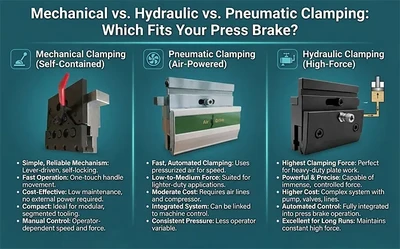 Mechanical vs. Hydraulic vs. Pneumatic Clamping: Which Fits Your Press Brake?September 8, 2026Choosing a press brake quick clamping system is not simply about finding the fastest option.Mechanical, pneumatic and hydraulic clamping systems each have different advantages.The right choice depends on your tooling, production volume, tool-change frequency and machine configuration.view
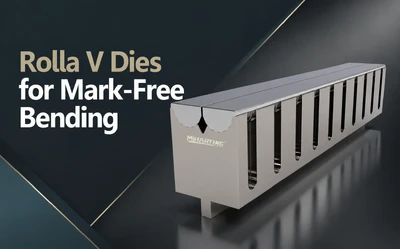 Rolla V Dies for Mark-Free Bending: How to Bend Stainless Steel without MarksJune 30, 2026For stainless steel fabricators producing elevator panels, kitchen equipment, architectural decoration, medical device covers, appliance panels, and premium metal enclosures, the surface quality of th...view