EN
EN

You bend a 3- or 4-meter sheet on a press brake.
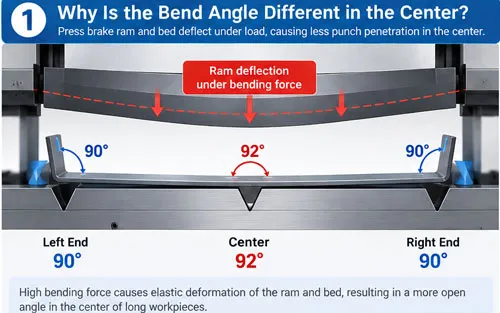
The left end measures 90°.
The right end measures 90°.
But the center measures 91° or 92°.
The first reaction is often to adjust the Y-axis or blame the press brake tooling.
But if both ends are correct while the center remains more open, the real problem may be press brake deflection.
This is exactly what a crowning system is designed to compensate for.
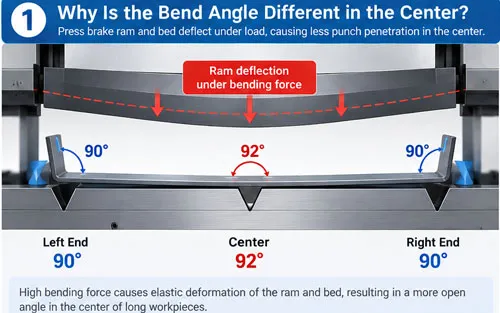
A press brake may look extremely rigid, but its ram and bed are not infinitely stiff.
During bending, high force causes small amounts of elastic deformation in the machine structure.
WILA explains that bending forces can deform both the upper and lower beams. This results in less punch penetration in the center, creating angular deviation along the workpiece.
In simplified form:
Bending Force
↓
Ram & Bed Deflect
↓
Less Penetration in the Center
↓
Center Angle Becomes More Open
For example:
Position | Bend Result |
Left | 90.0° |
Center | 91.5° |
Right | 90.1° |
If you simply increase the Y-axis penetration, you may correct the center—but then overbend both ends.
That is why a different solution is required.
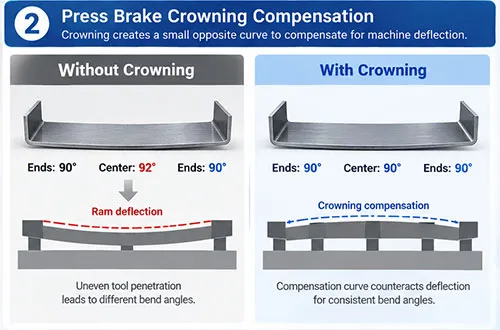
Crowning intentionally creates a small opposite curve along the bending length.
When bending force causes the machine to deflect, the crowning system compensates for that deformation.
Machine Deflection + Flat Table → Uneven Tool Penetration → Different Angles
Machine Deflection + Compensation Curve → More Uniform Penetration → Consistent Angles
The objective is not to make the unloaded machine perfectly flat.
The objective is to make the punch and die relationship as consistent as possible under bending load.
WILA describes adjustable crowning as an effective method of compensating for deflection across the complete machine length.
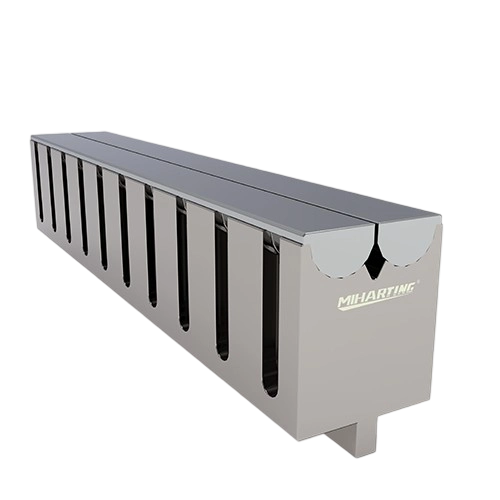
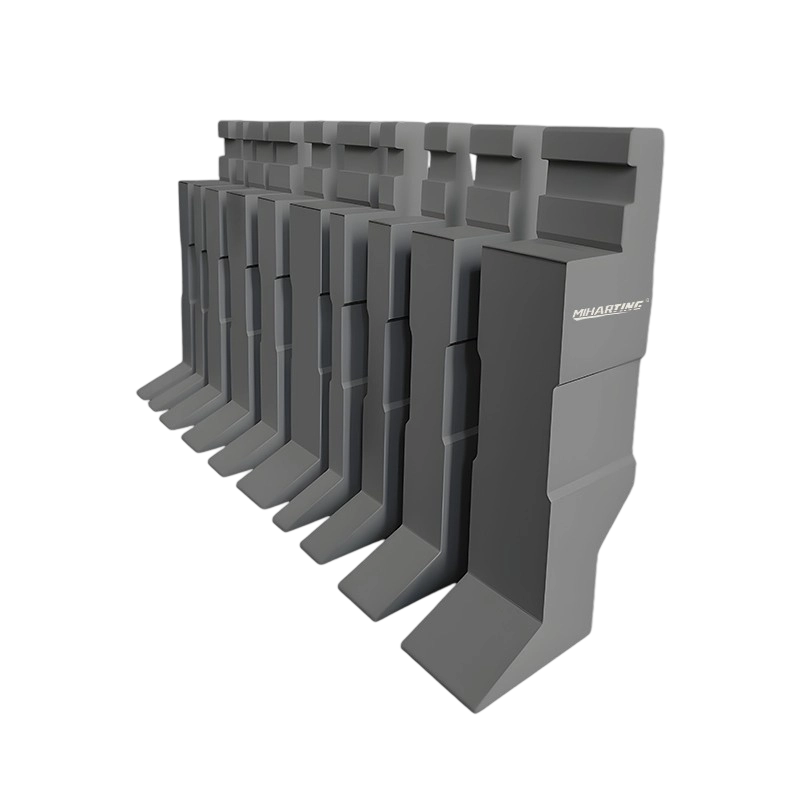
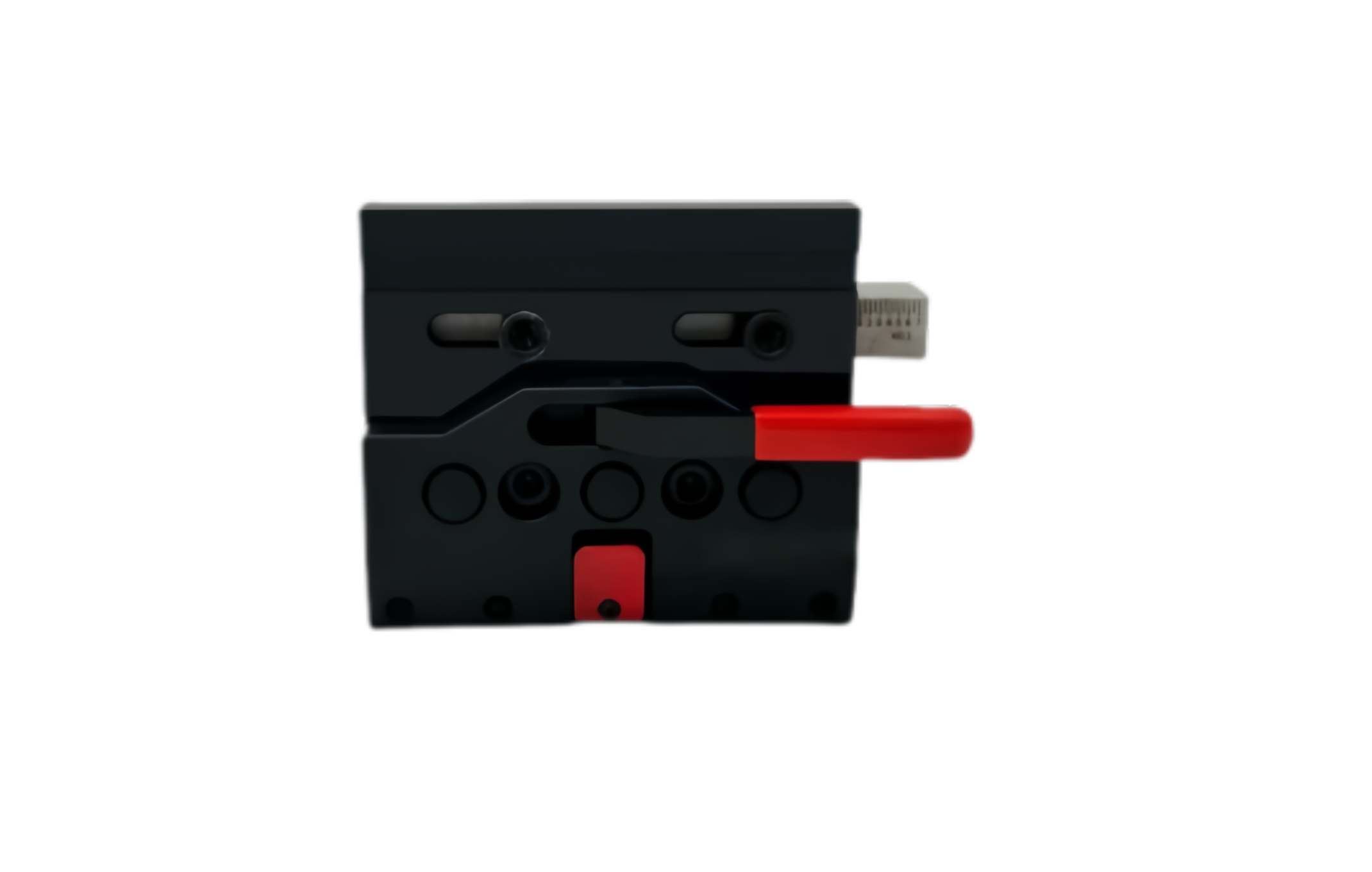
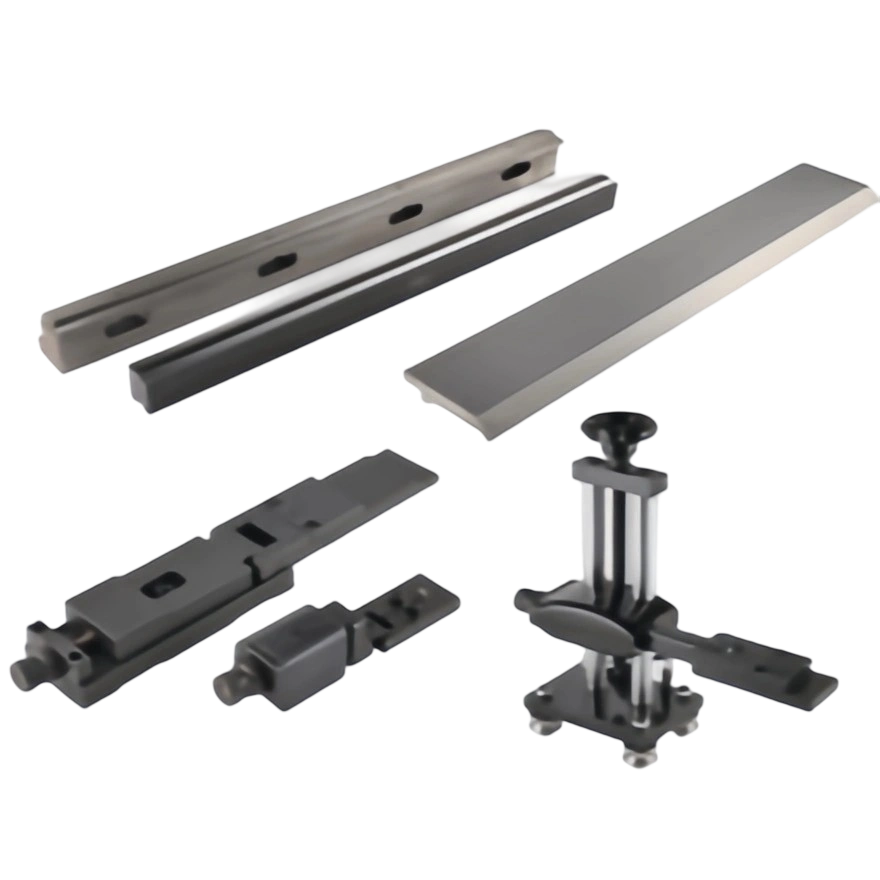
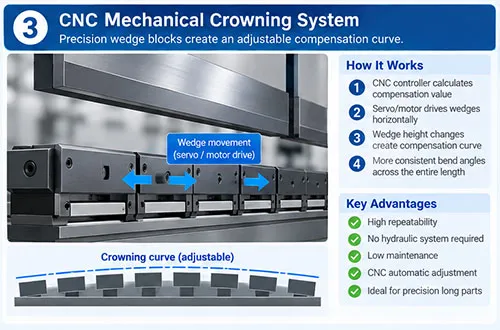
Mechanical crowning normally uses a series of precision wedge blocks installed along the lower table.
When the wedges move relative to one another, their combined height changes slightly.
This creates a controlled compensation curve.
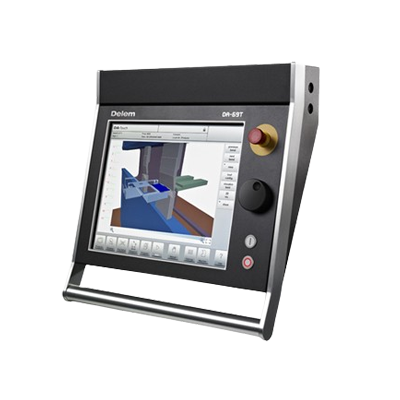
CNC Controller
↓
Servo / Motor Drive
↓
Wedges Move Horizontally
↓
Table Compensation Changes
↓
Deflection Is Corrected
The CNC can calculate or command a compensation value according to the bending program, while the mechanical wedge system physically creates the crown.
WILA's Wave Wedges are an example of this architecture: multiple adjustable wedges are tailored to the deflection characteristics of the individual press brake, and the system can use either manual or CNC-controlled adjustment.
✓ High repeatability
✓ Precise compensation curve
✓ No hydraulic compensation circuit required
✓ Relatively low maintenance
✓ CNC automatic adjustment available
✓ Local adjustment can compensate for machine tolerances
This makes mechanical wedge crowning particularly attractive for precision long-part bending.
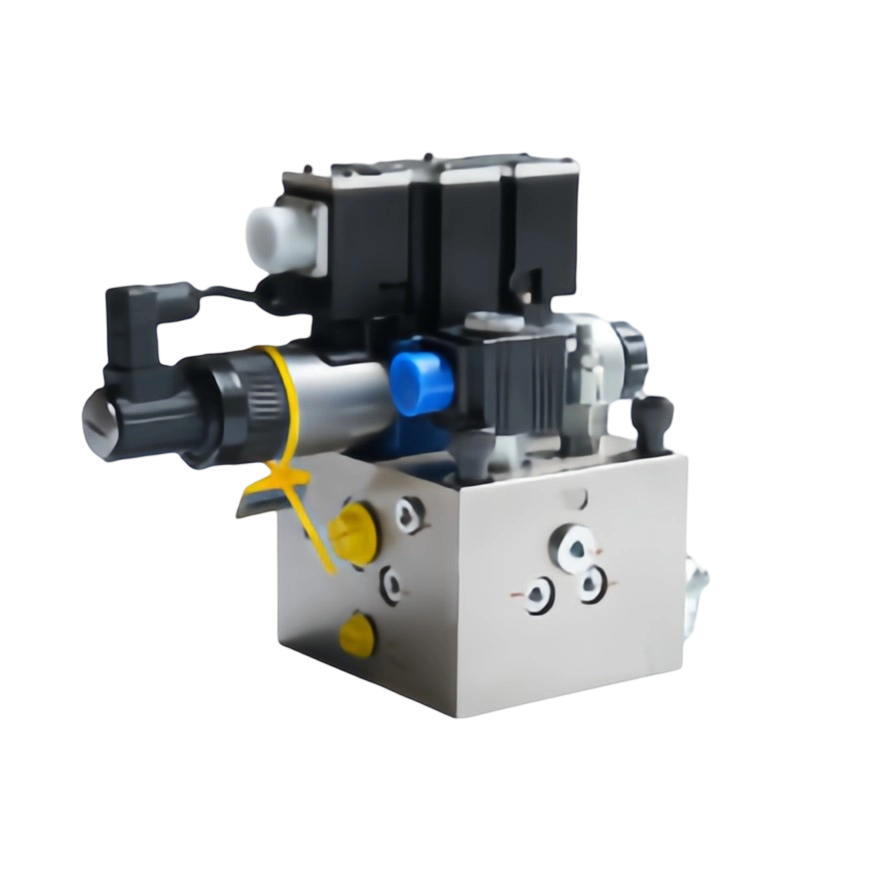
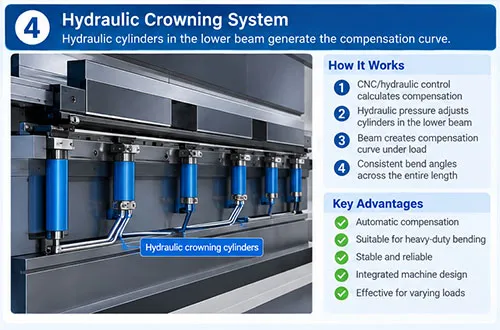
Hydraulic crowning uses hydraulic elements, typically incorporated into the lower beam, to generate the required compensation.
Instead of mechanically shifting wedge blocks:
CNC / Hydraulic Control
↓
Hydraulic Pressure
↓
Compensation Cylinders Act on Lower Beam
↓
Counter-Deflection Is Generated
WILA describes hydraulic crowning as using one or more cylinders in the lower beam; mechanical crowning, by contrast, uses wedges to generate the compensation curve.
✓ Automatic compensation capability
✓ Well suited to integrated machine designs
✓ Effective under varying bending loads
✓ Useful for heavy-duty bending applications
✓ No manual wedge adjustment required in automated configurations
The trade-off is additional hydraulic components, which means oil condition, seals, pressure stability and hydraulic maintenance become part of long-term accuracy management.
Factor | CNC Mechanical Crowning | Hydraulic Crowning |
Compensation method | Precision wedges | Hydraulic elements/cylinders |
CNC integration | Yes | Yes |
Repeatability | Excellent | Good–Excellent |
Local adjustment | Possible depending on design | Depends on machine design |
Hydraulic dependency | No | Yes |
Maintenance | Relatively low | Hydraulic maintenance required |
Retrofit potential | Better | More machine-dependent |
Best fit | Precision long-part bending | Integrated/heavy-duty applications |
There is no universal winner.
The correct system depends on the press brake design, bending length, load, accuracy requirement and production mix.
For products such as:
Electrical cabinets
Elevator panels
Stainless-steel enclosures
Long doors and panels
Architectural components
Long aluminum profiles
full-length angle consistency can be more important than simply achieving the correct angle at one measuring point.
A well-designed CNC mechanical wedge system is particularly attractive because the compensation curve can be engineered around the deflection characteristics of the press brake.
WILA emphasizes this point: each press brake model has different bending characteristics, so its crowning systems are tailored to the individual machine rather than using one universal compensation curve.
This is an important section for making the article genuinely useful.
Not every left-center-right angle difference is caused by crowning.
Bending Result | What to Check First |
Ends correct, center too open | Insufficient crowning |
Ends correct, center too closed | Excessive crowning |
Entire bend too open | Y-axis depth / program / springback |
Left and right angles different | Y1/Y2 synchronization / tooling alignment |
Random angle variation | Material variation / tool seating / contamination |
Localized angle problem | Tooling condition / local crowning adjustment |
Angle changes between batches | Material thickness / tensile strength |
A particularly useful diagnostic rule is:
If both ends are correct but the center is consistently wrong, investigate crowning and machine deflection first.
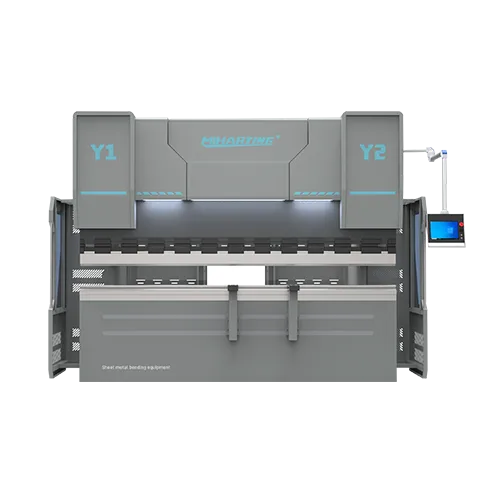
If one end differs from the other, the problem may instead involve machine alignment, Y1/Y2 synchronization or tooling.
There is no universal compensation value such as:
“A 3-meter press brake always needs 0.5 mm.”
The required compensation depends on:
Material + Thickness + Bend Length + V Opening + Bending Force + Machine Structure + Tooling
Higher bending force generally produces more structural deflection, but the exact compensation curve depends on the individual machine.
This is why modern CNC systems can integrate crowning values with the bending program rather than relying entirely on operator experience.
Crowning becomes increasingly valuable when:
✓ Bending long workpieces
✓ Using a large percentage of machine capacity
✓ Producing tight-tolerance parts
✓ Bending stainless or high-strength materials
✓ Angle consistency across the complete bend is critical
✓ Repeated trial bending is reducing productivity
For short parts positioned near the center of the machine, the effect of full-length deflection may be much less significant.
So the question is not simply:
“How many tons is my press brake?”
It is:
“How much does my machine deflect under the actual bending load and length?”
This is where mechanical crowning has an important advantage.
WILA states that its tool holders with integrated crowning and alignment can also be fitted to existing press brakes. By contrast, its technical explanation notes that hydraulic crowning built into the machine cannot simply be integrated into an existing press brake in the same way.
Therefore, for an older machine experiencing center-angle variation, an integrated mechanical crowning/tool-holder retrofit may be worth evaluating before replacing the press brake.
However, retrofit feasibility still depends on:
Table dimensions + Tooling height + Open height + Machine condition + Mounting interface
Crowning is not only about achieving a prettier measurement report.
Incorrect compensation creates:
Trial Bend → Measure → Adjust → Bend Again → Measure Again
A correctly configured CNC crowning system helps reduce this adjustment cycle.
For European manufacturers producing long precision components, that can mean:
More Consistent Angles
Less Rework
Less Scrap
Shorter Setup Time
Better Batch Repeatability
The real value of crowning is therefore not the wedge or hydraulic cylinder itself.
It is consistent bending across the entire usable length of the press brake.
Recommended reading:
Mechanical Compensation vs Hydraulic Crowning for Press Brakes
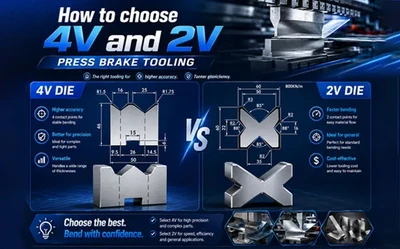 How to choose 4V and 2V press brake tooling?May 27, 2026How to choose 4V and 2V press brake tooling?What are their specific advantages,and for which applications are they best suited?This choice is a critical factor in determining your operational efficiency.We hope the following article will assist you in selecting the die best suited to your needs,thereby enhancing your production efficiency.view
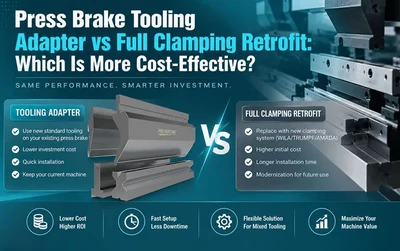 Press Brake Tooling Adapter vs Full Clamping Retrofit: Which Is More Cost-Effective?September 9, 2026Your press brake may still bend accurately after 10 or 15 years, but its tooling system can become a production bottleneck.This is common in European fabrication shops operating older machines with traditional European/Promecam or manufacturer-specific tooling interfaces.view
 Press Brake Tooling: Releasing the Brake for AerospaceJuly 25, 2025Why Aerospace Manufacturing Demands Next-Generation Press BrakesThe aerospace industry operates on razor-thin tolerances where a 0.1mm deviation can compromise entire assemblies.view
 Retrofitting Your Old Press Brake with Modern Quick-Change Clamping SolutionsSeptember 11, 2026Upgrade an older AMADA, LVD, SAFAN or European press brake with modern quick-change clamping. Compare adapters, mechanical, pneumatic and hydraulic retrofit solutions.view
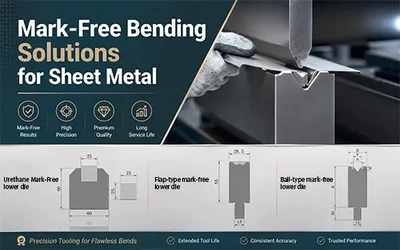 Mark-Free Bending Solutions for Sheet MetalJuly 27, 2026Learn three mark-free bending solutions for sheet metal: roller lower dies, urethane lower dies, and folding lower dies, including their best applications.view
 The Sheet Metal Maestro's Playbook: A Definitive Guide to Press Brake ToolingJuly 25, 2025When Metal Meets Its Match: The Science Behind Press BrakesPress brakes don't bend metal—they persuade it.view