EN
EN

If you operate an AMADA press brake, choosing tooling is not simply a matter of finding a punch and die with the right dimensions.
The tooling needs to match the machine interface, but it also needs to match the part being produced.
A tool that works well for a 2 mm electrical cabinet panel may not be the best choice for a thick stainless steel component. Likewise, a standard V die may not be suitable when the job requires a large inside radius, minimal surface marking or a special forming profile.
This guide looks at AMADA press brake tooling from a practical production perspective: how to identify the right tooling, how to select it for different applications, and when standard tooling should be replaced by a specialized solution.
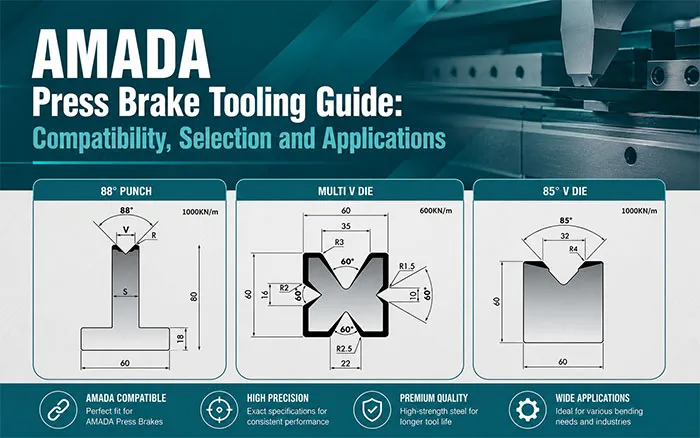
Before selecting a replacement or additional tool, start with the machine and the existing tooling.
Important information includes:
AMADA press brake model
Punch interface
Die interface
Tool height
Tool length
Clamping method
Required bending angle
Material type
Material thickness
Inside bend radius
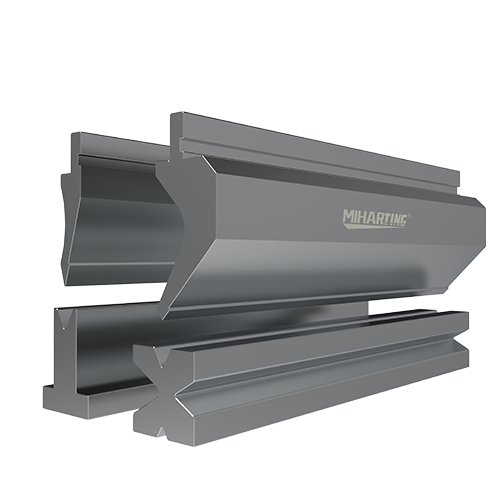
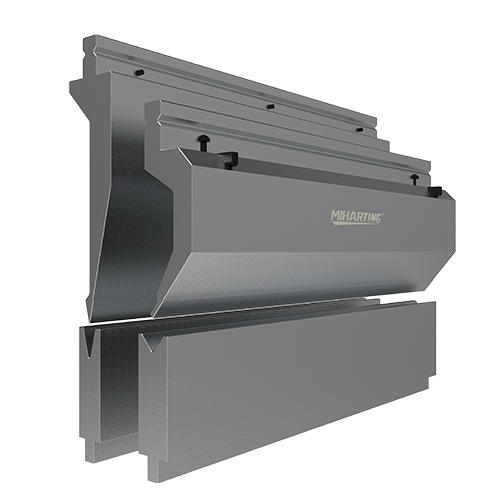
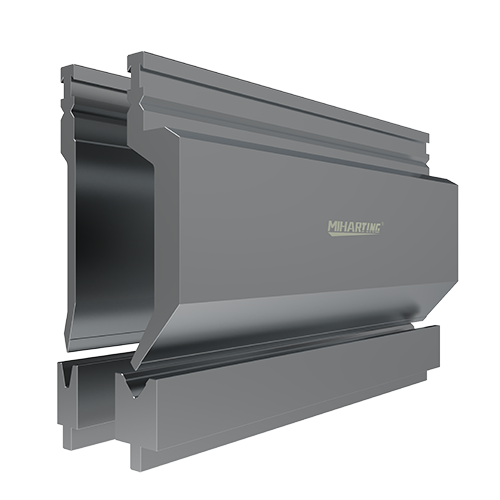
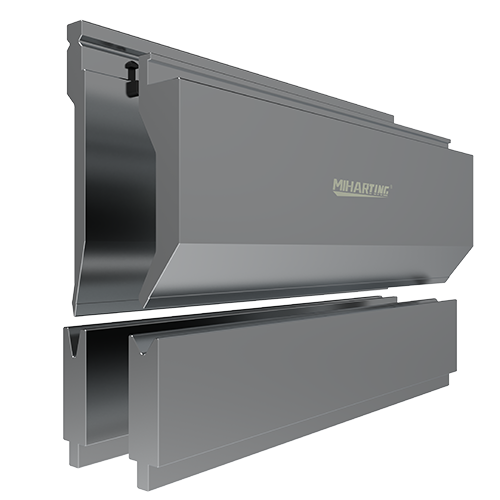
AMADA offers different press brake tooling configurations, including Euro Style and Fixed Height tooling for specific machine configurations.
Therefore, "AMADA compatible" should not be treated as a universal specification.
If you are unsure, providing the machine model, photos of the existing tooling or a tooling drawing is the safest way to confirm compatibility.
The punch determines the upper forming profile and has a direct influence on the minimum flange, inside radius and possible interference during bending.
A standard punch is suitable for common straight bends and general fabrication work.
It is a practical choice for:
Electrical enclosures
Machine covers
General sheet metal parts
HVAC components
A gooseneck punch provides additional clearance behind the punch tip.
It is useful when the workpiece has:
Deep channels
Return flanges
Previously formed sections
Box-shaped geometry
The additional clearance can prevent the existing flange from contacting the punch during the next bending operation.
When a component requires a larger inside radius, a radius punch can be more appropriate than a sharp standard punch.
Typical applications include:
Stainless steel parts
Aluminum components
Architectural panels
Large-radius bends
The lower die is equally important.
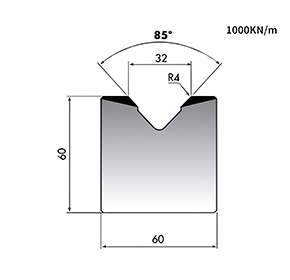
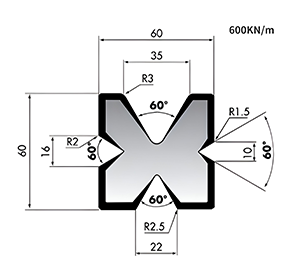
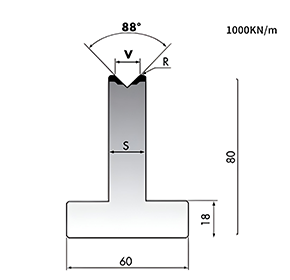
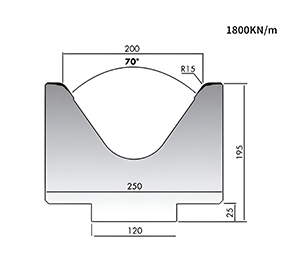
For most general bending operations, V dies are the starting point.
The correct V opening depends on:
Material thickness
Material strength
Required inside radius
Bending method
Machine capacity
Surface quality requirements
A commonly used starting point for air bending is approximately:
V = 6–8 × material thickness
However, this should be treated as a starting reference rather than a universal rule.
For production applications, the tooling manufacturer's recommendations and actual bending requirements should be considered.
Stainless steel creates different tooling requirements from mild steel.
The material is stronger and can be more sensitive to surface marking.
For stainless steel applications, consider:
An unsuitable V opening can increase bending force or create unnecessary surface pressure.
Damaged or rough die shoulders can leave visible marks on stainless steel.
A larger punch radius may be preferable when the drawing requires a larger inside bend radius.
For appearance-critical stainless steel components, specialized low-marking tooling or Rolla V solutions may be worth considering.
The objective is not simply to make the bend. It is to produce the required bend without creating unacceptable surface defects.
Electrical cabinet manufacturing often involves repeated 90-degree bends, short flanges, multiple bends and relatively thin sheet metal.
A typical tooling setup may include:
Standard punch
V die
Narrow V opening for thinner material
Segmented tooling for flexible production
For box-shaped cabinet components, punch clearance becomes particularly important.
A gooseneck punch can help reduce interference when previously formed sections move close to the upper tool during subsequent bends.
For manufacturers producing many different cabinet sizes, segmented tooling can also make setup more flexible.
Stainless steel enclosures often combine two requirements:
accurate bending + good surface appearance
In this application, tooling selection should focus on:
Correct V opening
Smooth die shoulders
Suitable punch radius
Tool hardness
Surface protection
If conventional tooling produces excessive marks, consider a low-marking or roller-based die solution.
This is especially relevant for visible surfaces where grinding or polishing after bending would increase production cost.
Thick plate requires a different approach.
Before selecting the tooling, calculate the required bending force and make sure the tooling is rated for the application.
The die should have an appropriate V opening, while the punch and die must have sufficient strength for the required load.
For heavy-duty applications, tooling material becomes particularly important.
Miharting uses 42CrMo alloy steel for its AMADA-compatible tooling, with heat treatment designed to balance hardness, strength and toughness.
The important point for buyers is:
Do not select tooling only by machine tonnage. Check the tooling's allowable load and application requirements as well.
Small parts create a different tooling challenge.
When the workpiece is short, the operator may need:
Short segmented tools
Narrow die openings
Small punch tips
Specialized tooling combinations
Segmented tooling allows operators to build the required tooling length from multiple sections instead of using one long tool.
This can reduce setup limitations when producing many small or different-shaped components.
Standard tooling covers a large percentage of sheet metal applications.
Custom tooling becomes worthwhile when the part cannot be produced efficiently with standard tools.
Examples include:
Special bending radius
Deep U-shaped profiles
Narrow channels
Long special profiles
Multiple bends with limited clearance
Special hemming operations
Low-marking requirements
A custom tooling request should ideally include the part drawing.
From the drawing, a tooling manufacturer can evaluate:
Punch geometry
Die geometry
V opening
Radius
Tool height
Clearance
Required tonnage
This is much more reliable than choosing a tool based only on a product photo.
Tool steel affects how the tooling performs under repeated bending loads.
Common materials used for press brake tooling include:
Good strength and toughness, suitable for demanding bending applications.
High hardness and wear resistance for general-purpose tooling.
A premium tool steel option for applications requiring high wear resistance and dimensional stability.
For daily production, the important question is not simply:
"Which material is hardest?"
It is:
"Which material and heat-treatment combination is appropriate for this application?"
For production shops that frequently change tooling or perform multi-stage bending, tooling height can become an important consideration.
AMADA's Fixed Height (AFH) tooling is designed around a consistent punch height, which can help reduce setup adjustments and make stage bending more convenient. AMADA describes its AFH system as a solution for reducing setup time and improving flexibility.
For shops with frequent tool changes, this type of configuration can be worth evaluating.
For simpler production, conventional tooling may still provide the better cost-to-performance balance.
Buying the cheapest tooling is not always the lowest-cost solution.
The actual tooling cost includes:
Purchase price + replacement frequency + setup time + scrap + downtime
Several practices can reduce the total cost:
Avoid unnecessary loading and premature wear.
Do not exceed the tooling's recommended capacity.
Metal particles and contamination can damage precision surfaces.
Wear can eventually affect bend consistency.
Keep tools dry, clean and protected from impact.
If the same parts are produced repeatedly, dedicated tooling sets can reduce setup time.
If you are purchasing replacement tooling from a third-party manufacturer, send as much information as possible.
Machine
AMADA model
Machine tonnage
Bending length
Tooling
Existing punch photo
Existing die photo
Tool dimensions
Clamping system
Workpiece
Material
Thickness
Bend angle
Inside radius
Part drawing
Quantity
Required punch length
Required die length
Segmentation requirements
This information allows the supplier to verify the tooling configuration before production.
| Application | Recommended Considerations |
|---|---|
| Electrical Cabinets | Standard punch + V die + segmented tooling |
| Stainless Steel | Smooth surface + suitable V opening + appropriate radius |
| Aluminum | Low-marking tooling + suitable radius |
| Thick Plate | Large V opening + high-load tooling |
| Small Parts | Segmented tooling + suitable punch clearance |
| Deep Boxes | Gooseneck punch + suitable die |
| Large Radius Bending | Radius punch/die |
| Hemming | Pre-bending + hemming tooling |
Before placing an order, ask:
1. Will the tooling physically fit my AMADA machine?
2. Does the punch match the clamping system?
3. Does the die fit the machine table or holder?
4. Is the V opening suitable for my material thickness?
5. Is the punch radius suitable for the required bend?
6. Can the tooling handle the required bending load?
7. Do I need standard or custom tooling?
8. Do I need segmented tooling?
9. Is surface marking a concern?
10. Can the supplier verify the tooling from my machine model or drawing?
If you can answer these questions before ordering, the risk of purchasing unsuitable tooling is greatly reduced.
AMADA press brake tooling should be selected according to the machine, material and application, rather than simply the brand name.
For general sheet metal work, standard punches and V dies provide a flexible solution. For deep boxes, large radii, stainless steel surfaces or special profiles, a more specialized tooling configuration may provide better results.
The right tooling can help improve:
Bend consistency
Surface quality
Setup efficiency
Tool life
Production flexibility
If you are unsure which AMADA-compatible tooling is suitable for your press brake, provide the machine model, current tooling photos, material thickness and part drawing. A professional tooling manufacturer can use this information to recommend the appropriate punch and die configuration before production.
 Centralized vs Machine-Side Tool Storage Cabinets: Which Cuts Press Brake Setup Time Faster?September 14, 2026Machine-side tool storage cabinets usually reduce press brake setup time faster in high-mix manufacturing environments because operators can access frequently used punches, dies, and accessories direc...view
 How Amada AFH Tooling Revolutionizes Setup Times in Precision Sheet Metal BendingApril 22, 2026In a world of “Just-in-Time” manufacturing, the longest part of the bending process is no longer the bend itself—it’s the setup. Amada AFH (Amada Fixed Height) tooling was designed to solve this. ...view
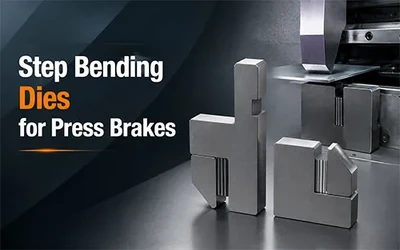 Step Bending Dies for Press BrakesAugust 4, 2026Discover Miharting step bending dies for press brakes, including DC01, DC02, and DC03 adjustable solutions. Improve offset bending accuracy, flexibility, and setup efficiency.view
 What Is a Proportional Valve? Definition, Function and Working PrincipleJanuary 8, 2026A proportional valve is an electrically controlled valve that continuously regulates fluid flow, pressure, or direction according to a variable command signal. Unlike a conventional on/off valve, whic...view
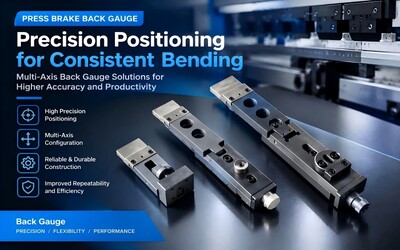 Press Brake Back Gauge Calibration: 7 Signs Your Positioning System Needs AdjustmentSeptember 18, 2026A press brake may produce the correct bend angle while still delivering inconsistent flange dimensions from one part to the next. In many cases, the problem is not the bending force or the tooling its...view
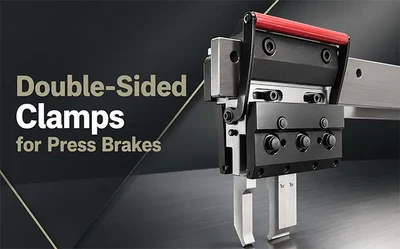 Double-Sided Clamps: The Smarter Way to Expand Press Brake Bending FlexibilityJune 23, 2026Discover how FAST double-sided clamps help press brake users achieve front and rear tool clamping, faster setup, safer operation, and lower tooling costs.view