EN
EN

When buying press brake tooling, many customers focus on one number: hardness.
A higher HRC value may look better on a specification sheet, but does higher hardness always mean better tooling?
Not necessarily.
For press brake punches and dies, the right material needs to balance hardness, toughness, wear resistance and application requirements. A material that performs well in high-volume production may be unnecessary for a general sheet metal workshop.
Two commonly used options are 42CrMo and Cr12MoV. So, which one should you choose?
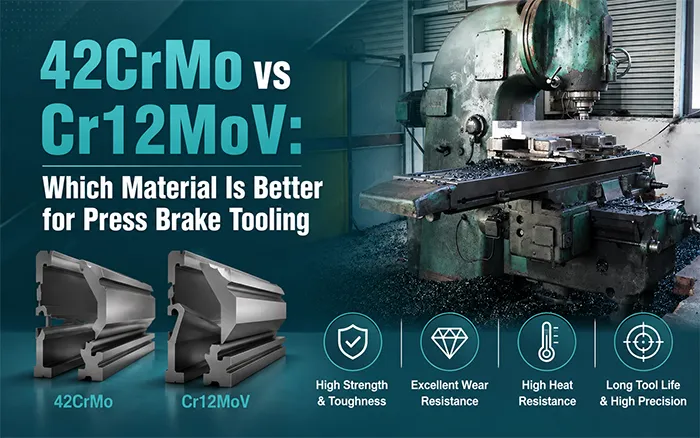
Material | Typical Hardness | Main Advantage | Typical Application |
42CrMo | HRC 47–52 | High toughness and balanced performance | General bending, heavy-duty applications |
Cr12MoV | HRC 58–62 | High hardness and wear resistance | High-volume and wear-intensive applications |
Final hardness depends on tooling design and heat-treatment process.
42CrMo is a high-strength alloy steel widely used for press brake tooling.
Its main advantage is the balance between strength, toughness and wear resistance.
This makes it suitable for applications where tooling is exposed to repeated bending loads or occasional impact.
Mild steel bending
General sheet metal fabrication
Medium and heavy-duty bending
Large press brake tooling
Applications where toughness is important
42CrMo is particularly attractive for manufacturers who want reliable performance without paying for an unnecessarily high-hardness material.
In simple terms: 42CrMo is a versatile workhorse.
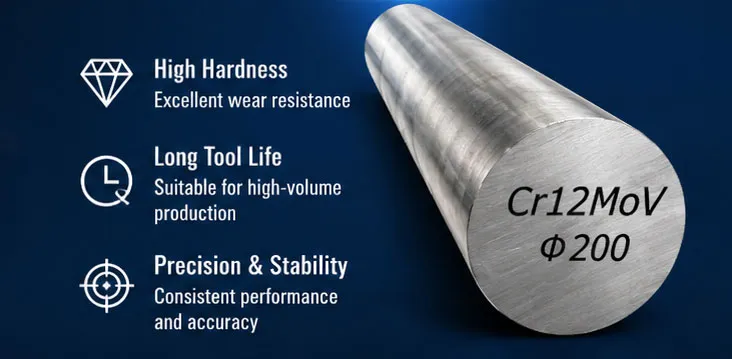
Cr12MoV is a high-carbon, high-chromium tool steel designed for higher hardness and wear resistance.
Its advantage becomes more noticeable when tooling is used continuously and wear on the punch tip or die shoulders becomes a major concern.
High-volume production
Frequent bending cycles
Wear-intensive applications
Stainless steel processing
Precision tooling requiring good dimensional wear resistance
However, higher hardness comes with a trade-off. Compared with 42CrMo, Cr12MoV generally offers less toughness, so tooling design, heat treatment and operating conditions become particularly important.
In simple terms: Cr12MoV is a specialist for wear resistance.
There is no universal winner.
The better material depends on what you bend, how often you bend it, and how heavily the tooling is loaded.
You need general-purpose tooling
Your production involves different materials and thicknesses
Toughness is important
The tooling experiences significant impact or load
You want a good balance between cost and service life
Tool wear is a major concern
You run high-volume production
The same tooling is used for long production cycles
High hardness and wear resistance are priorities
Dimensional stability over extended use is important
This is one of the most common mistakes when purchasing press brake tooling.
A die with 60 HRC is not automatically better than one with 50 HRC.
Hardness improves wear resistance, while toughness helps the tool withstand impact and heavy loading.
For example, using an extremely hard material for a relatively light-duty application may increase the purchase cost without delivering a meaningful production benefit.
On the other hand, selecting a material with insufficient wear resistance for continuous high-volume production can result in frequent tooling replacement and inconsistent bending results.
The goal is to find the right balance for your actual production conditions.
Even the right steel can perform poorly if the manufacturing process is not controlled.
When evaluating press brake tooling, also consider:
Heat treatment
Working-surface hardness
Precision grinding
Straightness
Tool geometry
Hardening depth
Quality inspection
A professional tooling manufacturer should select the material and heat-treatment process according to the actual application, rather than simply providing a high HRC number.
Before ordering press brake tooling, provide your supplier with:
Material → Thickness → Bending method → Production volume → Required radius → Machine tonnage
This information makes it easier to determine whether you need the balanced toughness of 42CrMo or the higher wear resistance of Cr12MoV.
If you are still unsure, a tooling manufacturer can recommend the material based on your actual part drawings and production conditions.
So, 42CrMo vs Cr12MoV — which is better for press brake tooling?
The answer depends on the job.
42CrMo is a strong all-round choice when toughness, reliability and cost balance are important.
Cr12MoV is better suited to applications where high hardness and wear resistance are more important, particularly in demanding or high-volume production.
That approach usually leads to better tooling performance, longer service life and lower total production costs.
Miharting supplies press brake punches and dies in different materials, hardness levels and configurations. Send us your machine model, material thickness and bending application for a suitable tooling recommendation.
 WILA Press Brake Tooling vs Traditional Tooling: Which Is Better?August 26, 2026Choosing press brake tooling is not just a purchasing decision. It affects setup time, bend accuracy, operator safety, scrap rate, machine utilization, and whether your shop can handle short-run jobs profitably.view
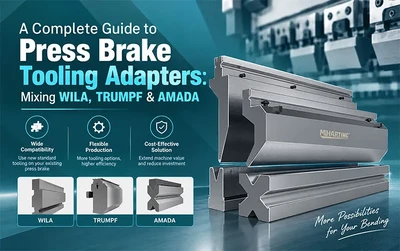 A Complete Guide to Press Brake Tooling Adapters: Mixing WILA, TRUMPF & AMADASeptember 9, 2026Many European fabrication shops have press brakes that are 10, 15 or even 20+ years old but still mechanically reliable.This is where a press brake tooling adapter can become a practical solution.view
 What Role Does the Bending Machine Mold Play in Improving the Safety Performance of Automobiles?June 26, 2025Press brake machine molds play a vital role in improving the safety performance of automobiles. Specifically, in the automobile manufacturing process, press brake machine molds are mainly used to shap...view
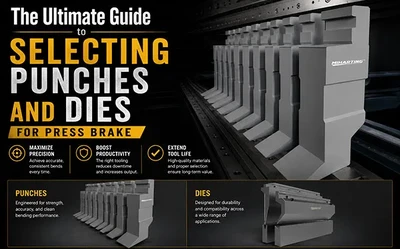 The Ultimate Guide to Selecting Punches and Dies for Press BrakeJune 1, 2026Bending tools—press brake punches and dies—serve as the "teeth" of metal fabrication; they directly determine both the precision of the finished product and the service life of the machine tool. In this article, we will guide you through a systematic approach to selecting the most suitable tooling, examining four key dimensions: material, geometry, V-die selection, and compatibility.view
 What Are the Differences in the Demand for Bending Machine Molds for New Energy Vehicles?June 26, 2025Compared with traditional vehicles, the demand for press brake toolings of new energy vehicles is significantly different, which is mainly reflected in the following aspects:1. Application of lightwei...view
 How to Bend Sheet Metal by HandJanuary 8, 2026Bending sheet metal by hand is a skill that can save time and money, and it can be essential for custom projects where machine bending isn't feasible. Understanding the correct tools required and ...view