EN
EN

Buying Bystronic press brake tooling requires more than matching the machine brand. You need the correct interface, tooling geometry, load capacity, and bending specifications for reliable production.
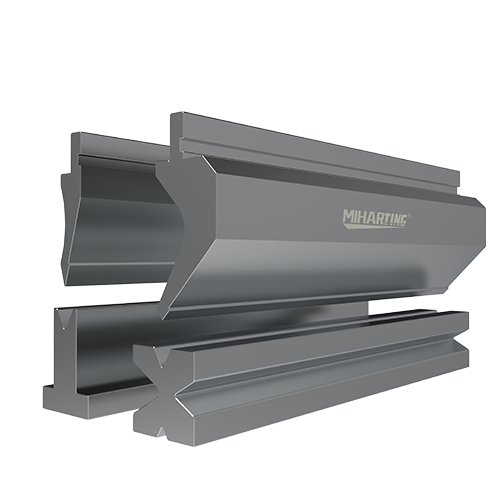
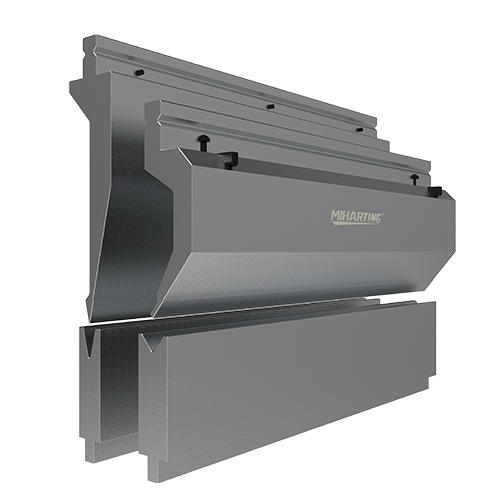
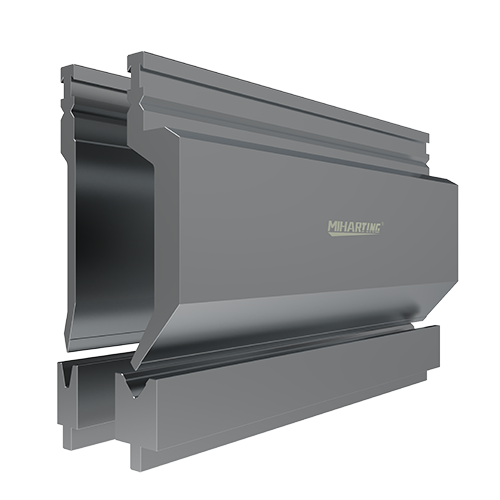
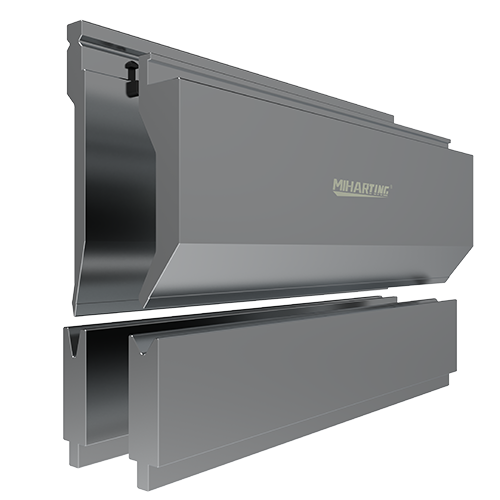
Bystronic press brakes can use XPT, RF-A, RF-AC, Euro-B, 3-P, R, and other tooling configurations. You should confirm your machine model, tooling interface, working height, and application before ordering. Correct compatibility helps you avoid installation problems, bending errors, and unnecessary tooling costs.
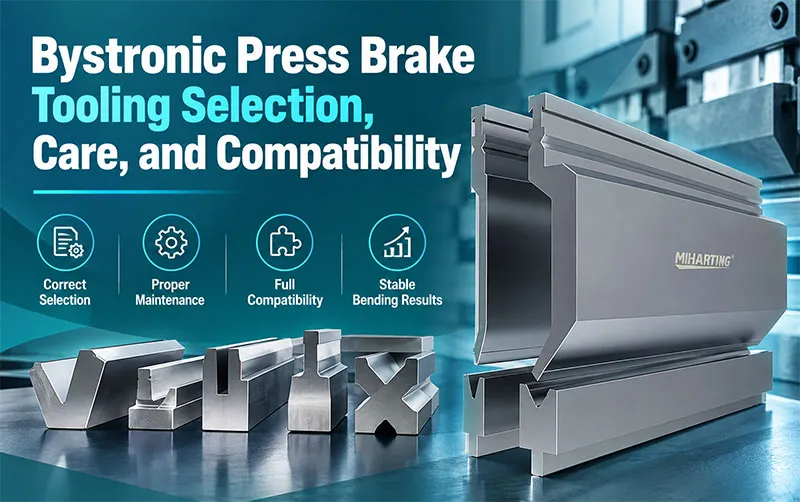
You should identify your tooling system before choosing any replacement punch or die. Bystronic machines do not all use the same tooling interface.
Bystronic currently lists tooling families including XPT, RF-A, RF-AC, Euro-B, 3-P, and R. The available configuration depends on the press brake model and machine setup.
This means “Bystronic tooling” alone is not enough information for accurate selection. You should check your existing tooling and clamping system first.
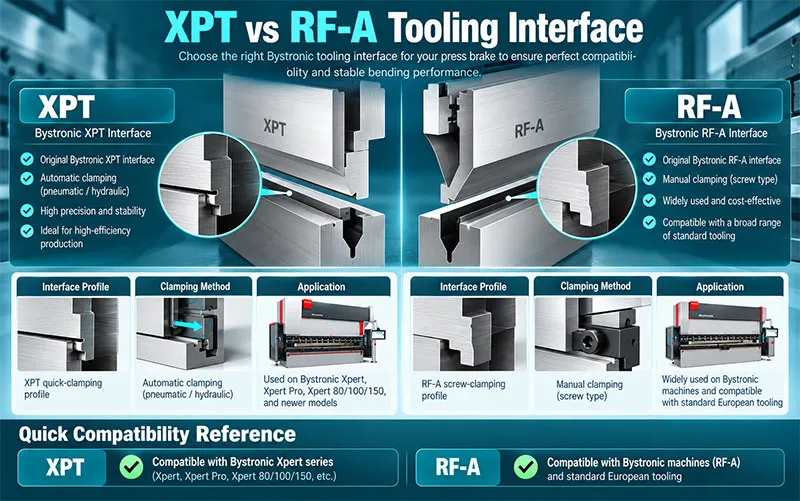
XPT is an important option if you already use WILA-style tooling in your workshop. Bystronic states that XPT supports WILA NSCL II-type hydraulic clamping and tooling compatibility.
This compatibility can help you use an existing tooling library across suitable machines. It may also reduce the need to purchase duplicate tooling.
However, you should never assume every WILA tool fits every Bystronic press brake. You still need to confirm the tang, working height, holder, load capacity, and actual machine configuration.
RF-A uses a different tooling concept from XPT. Bystronic describes RF-A tooling as segmented, self-seating, and front-loading.
Front loading can make tool changes easier because you do not need to slide long tools from the machine side. Self-seating also helps you position tooling correctly during clamping.
RF-A can be combined with hydraulic upper and lower clamping configurations. This makes it suitable for production environments with frequent tooling changes.
You should not treat XPT and RF-A as interchangeable tooling systems. They use different tooling and clamping concepts.
XPT is particularly relevant when you need WILA NSCL II-type compatibility. RF-A focuses on its own front-loading and self-seating tooling architecture.
If you cannot identify your system, send photos of your punch, die, and holders. Add accurate dimensions to the photos whenever possible.
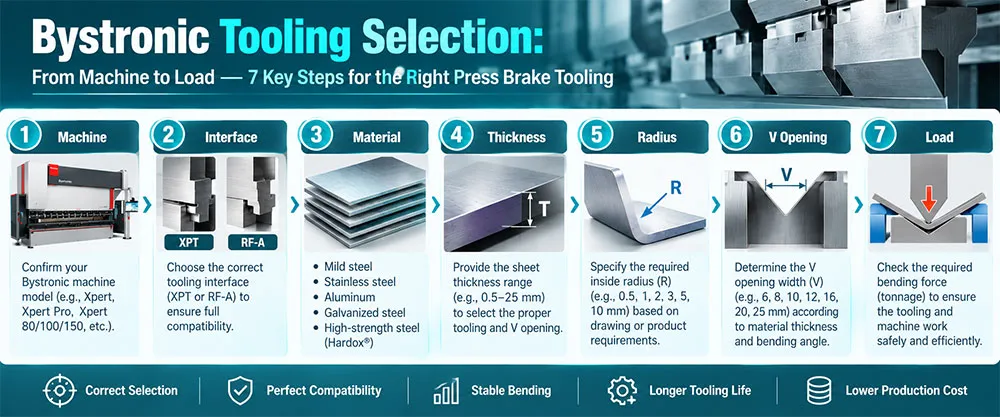
You should check compatibility at three levels before placing an order. A tool that fits mechanically may still be unsuitable for your actual bending application.
First, confirm your exact Bystronic model, tonnage, and bending length. You should also provide the machine year when this information is available.
Older machines may have modified tool holders or clamping systems. You should therefore inspect the actual machine instead of relying only on the original model specification.
Next, check your punch tang, lower die interface, working height, and clamping method. These dimensions determine whether your replacement tooling can be installed correctly.
You should also check tooling segmentation when replacing an existing set. Different segment combinations can affect your setup flexibility.
Finally, check whether the tooling can produce your actual workpiece. You need to consider material, thickness, bend length, angle, inside radius, and minimum flange.
You should also calculate the required bending force. Your punch, die, holder, and press brake must remain within their allowable loads.
You should choose punch geometry from the finished component rather than appearance. Different part shapes require different clearance around the punch.
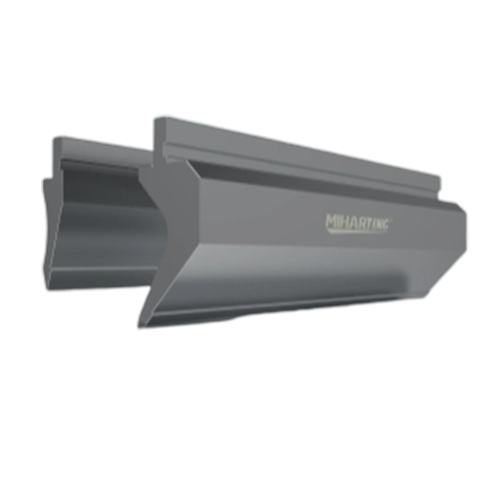
A straight punch works well for many simple bends. A gooseneck punch provides additional clearance for boxes, channels, and return flanges.
For thick plate or high-strength steel, you may need a larger punch radius. You should select the radius according to material properties and the required finished geometry.
Your V opening affects bending force, inside radius, minimum flange, and material contact. You should never choose it from sheet thickness alone.
Around eight times the material thickness is often used as an initial reference for air bending. Bystronic also discusses this relationship in its tooling selection guidance.
However, you may need a different opening for special materials or part requirements. Always consider thickness, material strength, inside radius, flange length, and available tonnage together.
You need enough material supported across the die shoulders during bending. A flange that is too short for the selected V opening can create an unstable setup.
A wider V opening can reduce required bending force. However, it also increases the minimum flange requirement and normally increases the natural inside radius.
You should therefore provide your minimum flange when requesting tooling. This information is especially important for small and complex parts.
Tooling compatibility does not stop at the interface. Punch and die height also affect the available bending space.
You should pay close attention to this when producing deep boxes or large return flanges. The workpiece needs enough space to complete each bend without collision.
Bystronic provides tooling and free-space information because tool geometry directly affects bending clearance.
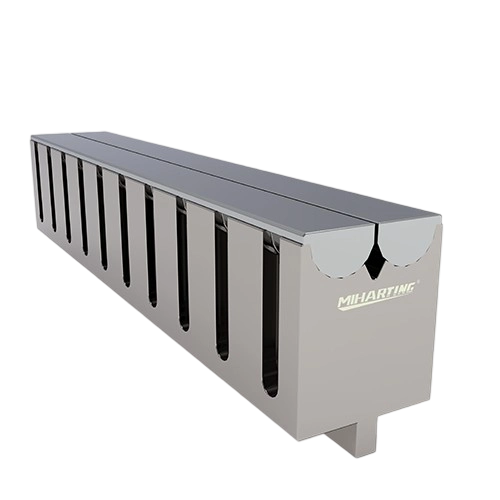
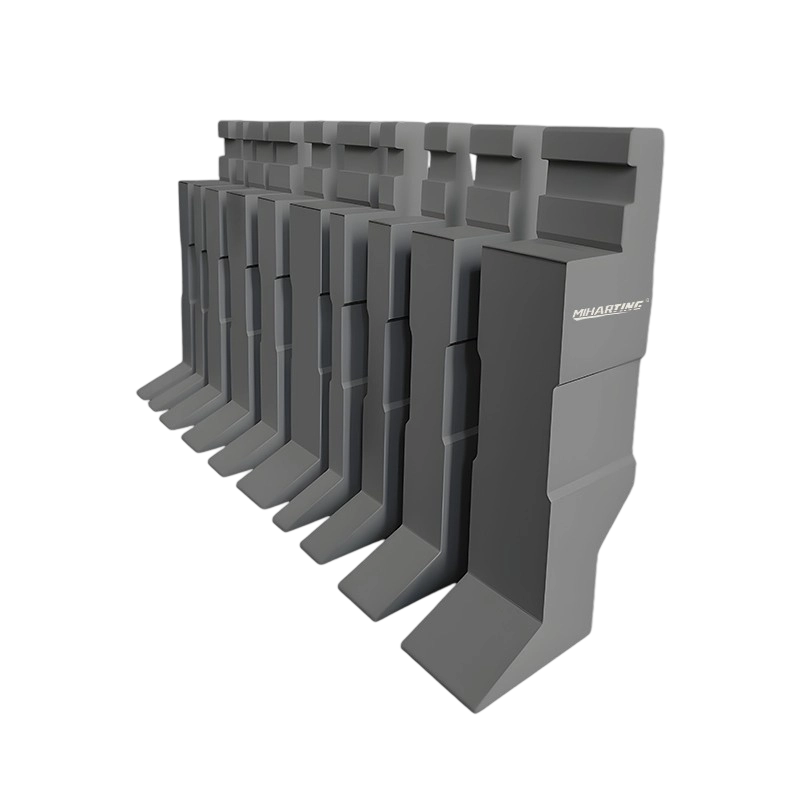
You should consider segmented tooling if your production changes frequently. Different segments allow you to build several working lengths from one tooling set.
Shorter segments are also easier to handle during setup. This can help when you produce small batches and many different component sizes.
Before ordering, decide which segment lengths you actually need. A practical segmentation plan can make one tooling set useful for more jobs.
If you use automatic tool changing, you need additional compatibility checks. The tooling must work with both the bending process and the automation system.
Bystronic's automated tool-changing systems select and position tooling according to the programmed bending job. Tool dimensions, segmentation, storage, and handling therefore become important.
You should tell your tooling supplier about automation before ordering. A tool may bend correctly but still be unsuitable for automatic handling.
You should consider custom tooling when standard profiles cannot produce your component efficiently. This often happens with complex geometry or unusual clearance requirements.
Common applications include deep boxes, Z bends, offsets, special channels, large radii, and return flanges. Heavy-duty applications may also require specially designed tooling.
For custom tooling, send your supplier a complete part drawing. A PDF, DXF, or STEP file makes geometry and interference analysis easier.
Heavy-duty bending requires more than a stronger punch. You need to evaluate the complete load path.
The bending force travels through the ram, clamp, punch, workpiece, die, holder, and machine table. Every component needs sufficient load capacity.
You should provide the material grade, tensile strength, thickness, and bending length. These details help your supplier evaluate the required tooling capacity.
You should keep the punch, die, and clamping interfaces clean. Metal particles and dirt can prevent tooling from seating correctly.
Inspect punch tips and die shoulders for wear, dents, and local damage. Damaged geometry can change your bending results even when the CNC program remains unchanged.
You should also protect tooling against moisture during storage. Organized storage helps you prevent damage and find the correct tooling faster.
You do not need to wait until a tool breaks before replacing it. Wear can gradually reduce bending consistency long before complete failure occurs.
Check the punch radius, die shoulders, locating surfaces, and segmented joints. Compare frequently used tools with a known good section when accuracy begins to change.
If one tooling section produces different results, inspect that section first. This can save you from unnecessary machine adjustments.
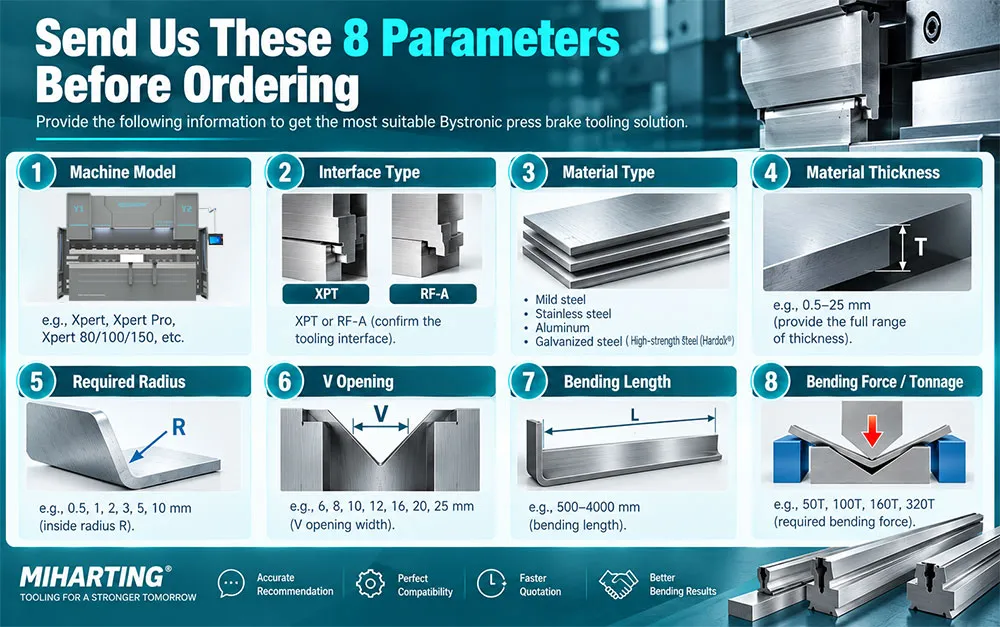
The more accurate your information, the easier it is to select the correct Bystronic press brake tooling.
Information | Example |
Machine model | Bystronic Xpert Pro |
Machine tonnage | 150 ton |
Bending length | 3000 mm |
Tooling system | XPT / RF-A / Other |
Clamping type | Hydraulic / Mechanical |
Material | S355 |
Thickness | 4 mm |
Bend length | 2000 mm |
Required angle | 90° |
Inside radius | 4 mm |
Minimum flange | 30 mm |
Tool required | Punch / Die / Complete Set |
Part drawing | PDF / DXF / STEP |
You should also send clear photos of your existing tooling and clamping system. Include interface dimensions if you are unsure about the tooling standard.
One common mistake is ordering tooling using only the Bystronic machine name. You should confirm the actual tooling system before purchasing.
Another mistake is assuming XPT and RF-A are interchangeable. Their tooling architectures are different, so you should evaluate them separately.
You should also avoid selecting a V opening using only material thickness. Required radius, minimum flange, material strength, and bending force also affect your choice.
No. Bystronic uses several tooling systems across different press brake configurations. You should confirm the machine, holder, interface, and working height before ordering.
Bystronic states that XPT is compatible with WILA NSCL II-type hydraulic clamping and tooling systems. You should still verify dimensions, working height, and load capacity.
RF-A is a Bystronic tooling system with segmented, self-seating, and front-loading features. Hydraulic upper and lower clamping configurations are also available.
Yes. You should inspect the actual holder and tooling interface before ordering. Older machines may have modified clamping or tooling systems.
Yes. Custom tooling can support special profiles, offsets, radii, boxes, and heavy-duty applications. You should provide your machine information and workpiece drawing first.
Send your machine model, tonnage, interface photos, material, thickness, bend length, inside radius, and minimum flange. Include a part drawing for complex applications.
Correct Bystronic press brake tooling should match your machine interface, bending load, and finished part. Send Miharting your machine model, tooling photos, dimensions, and part drawing, and we can help you evaluate a suitable standard or custom tooling solution.
Get a Bystronic Tooling Recommendation
 4 Way Press Brake Die: An Efficient Production SolutionJuly 14, 2026A 4 way press brake die, also known as a 4 way die, four-sided die, or multi V lower die, integrates multiple V openings into one die body. It can effectively reduce die changeover time, lower tooling costs, and improve bending flexibility.view
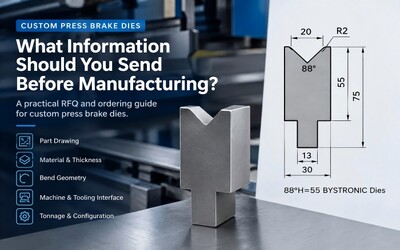 Custom Press Brake Dies: What Information Should You Send Before Manufacturing?September 18, 2026Custom Press Brake Dies: What Information Should You Send Before Manufacturing? | MIHARTINGOrdering a custom press brake die often starts with a straightforward request: a customer has a part that can...view
 Double-Sided Clamps: The Smarter Way to Expand Press Brake Bending FlexibilityJune 23, 2026Discover how FAST double-sided clamps help press brake users achieve front and rear tool clamping, faster setup, safer operation, and lower tooling costs.view
 Press Brakes Don't Just Bend Metal - They Bend the RulesJuly 25, 2025The Basics and Trends of Sheet Metal Manufacturing IndustrySheet metal remains the backbone of countless industries, from automotive frames to aerospace components.view
 LVD Press Brake Tooling: STONE Radius & Custom SolutionsSeptember 23, 2026Learn how to select LVD press brake tooling, including LVD10, LVD15, LVD30, W Style, STONE radius dies, heavy-duty tooling and custom solutions.view
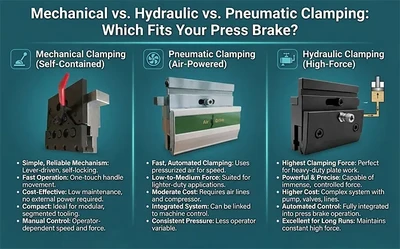 Mechanical vs. Hydraulic vs. Pneumatic Clamping: Which Fits Your Press Brake?September 8, 2026Choosing a press brake quick clamping system is not simply about finding the fastest option.Mechanical, pneumatic and hydraulic clamping systems each have different advantages.The right choice depends on your tooling, production volume, tool-change frequency and machine configuration.view